Icon treatment and health insurance: costs & reimbursement
Icon treatment is a minimally invasive method for early tooth decay and white spots. It can help treat early tooth damage without a conventional filling.
Many patients therefore ask whether their health insurance will cover the cost. As a rule, however, the Icon method is classed as a private treatment. At Wunschlachen, we examine your findings carefully and explain the possible costs transparently.
Über 350 Google-Bewertungen
What is Icon treatment?
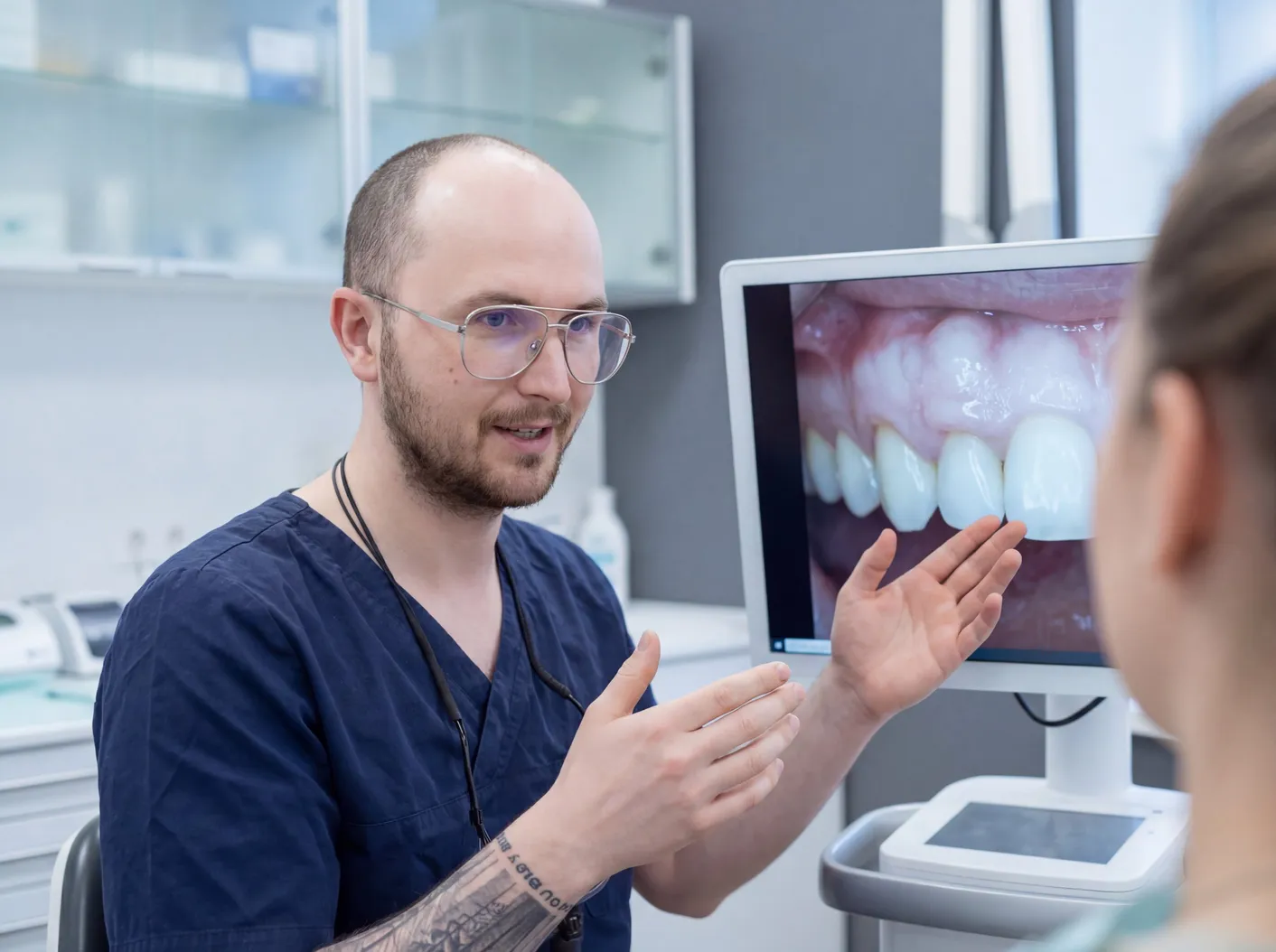
Icon treatment is also known as caries infiltration. Early tooth decay is infiltrated with a low-viscosity resin. The material penetrates the porous areas of the tooth enamel.
This can stabilise the damaged tooth substance. The tooth usually does not need to be drilled conventionally. The procedure is particularly suitable for very early lesions.
Icon is often used for white spots. These are light-coloured patches on the teeth. They often occur after fixed braces or as a result of demineralisation.

Does health insurance cover Icon treatment?
German statutory health insurance usually does not cover the full cost of Icon treatment. This is because the method is often not classified as part of standard care.
Statutory insurers mainly cover medically necessary standard treatments, such as certain fillings for more advanced tooth decay. Icon treatment is often charged as an additional service.
Patients with statutory insurance therefore often pay for the treatment themselves. Some insurers may contribute in exceptional cases. It is worth asking yours in advance.

Icon treatment costs: what do they depend on?
The costs depend on your individual clinical findings. The most important factor is the number of tooth surfaces affected. The location of the areas also plays a role.
White spots on front teeth often require particular care. The aesthetic result is very important here. Spaces between teeth can also be more complex to treat.
At Wunschlachen, you receive a clear assessment in advance. We explain which surfaces can be treated. You then receive transparent cost information.

Why is Icon not a conventional filling?
A conventional filling replaces tooth substance that has already been lost. Diseased tissue usually has to be removed for this. Icon, by contrast, is used much earlier.
The method uses infiltration rather than building up a filling. It targets early enamel changes. The tooth is preserved as conservatively as possible.
This particular feature affects billing. Health insurance funds assess modern supplementary methods differently from standard fillings. Patients therefore often have to pay part of the cost themselves.

When is it worth asking your health insurance fund?
It is particularly worth enquiring before treatment begins. This way, you will know early on whether a subsidy is possible. The same applies if you have dental supplementary insurance.
Private insurers decide according to the policy. Some policies partially reimburse aesthetic or preventive measures. Others exclude such treatments.
Submit the planned treatment in writing for this purpose. Photographs or a dentist's explanation may also help. Our team will support you with the necessary documents.

Which documents help with reimbursement?
Clear documentation is helpful when making an enquiry. This includes the diagnosis, treatment plan and estimated costs. The reason for the treatment should also be described clearly.
With white spots, the issues are often aesthetics and tooth enamel. With initial caries, the focus is on early preservation of the tooth. This distinction can be important for insurers.
Keep your health insurance fund's response in a safe place. This makes the subsequent steps easy to follow. If you have any questions, our practice team will be happy to help.

Who is the Icon method suitable for?
The Icon method is suitable for early tooth decay in the enamel. Visible demineralisation spots can also be treated. It is essential that there is not yet a large cavity.
Icon is not sufficient for deep tooth decay. A filling or further treatment may then be necessary. This is why precise diagnostics are particularly important.
We examine your teeth using modern examination methods. We then explain the appropriate therapy to you. This helps you avoid unnecessary treatments.

How does the treatment work?
First, the affected areas are thoroughly cleaned. The dentist then prepares the surface in a targeted manner. The infiltration material is then applied.
The material penetrates the porous areas. It is then hardened with light. Finally, the surface is smoothed and checked.
The procedure is usually straightforward. The exact duration depends on the number of areas. The location of the tooth surfaces also affects the amount of work involved.
Advantages of Icon treatment at Wunschlachen
Icon can preserve healthy tooth substance. Treatment is often completed quickly. It can also improve the appearance of white spots.
Many patients appreciate this early treatment approach. Small areas of damage are treated before larger defects develop. This can support long-term tooth preservation.
At Wunschlachen, we combine aesthetics and dental health. We provide clear advice without pressure. You will find out exactly which options suit your clinical findings.

Conclusion: Icon treatment and health insurance
Icon treatment is a modern option for initial caries and white spots. However, statutory health insurance usually does not cover the costs in full. It is often a private supplementary treatment.
Nevertheless, it may be worth having your case reviewed. Some insurers or supplementary insurance providers contribute in individual cases. At Wunschlachen, you receive clear advice on your clinical findings, the procedure and the costs.