Sensitive teeth: what happens inside the tooth – and what helps
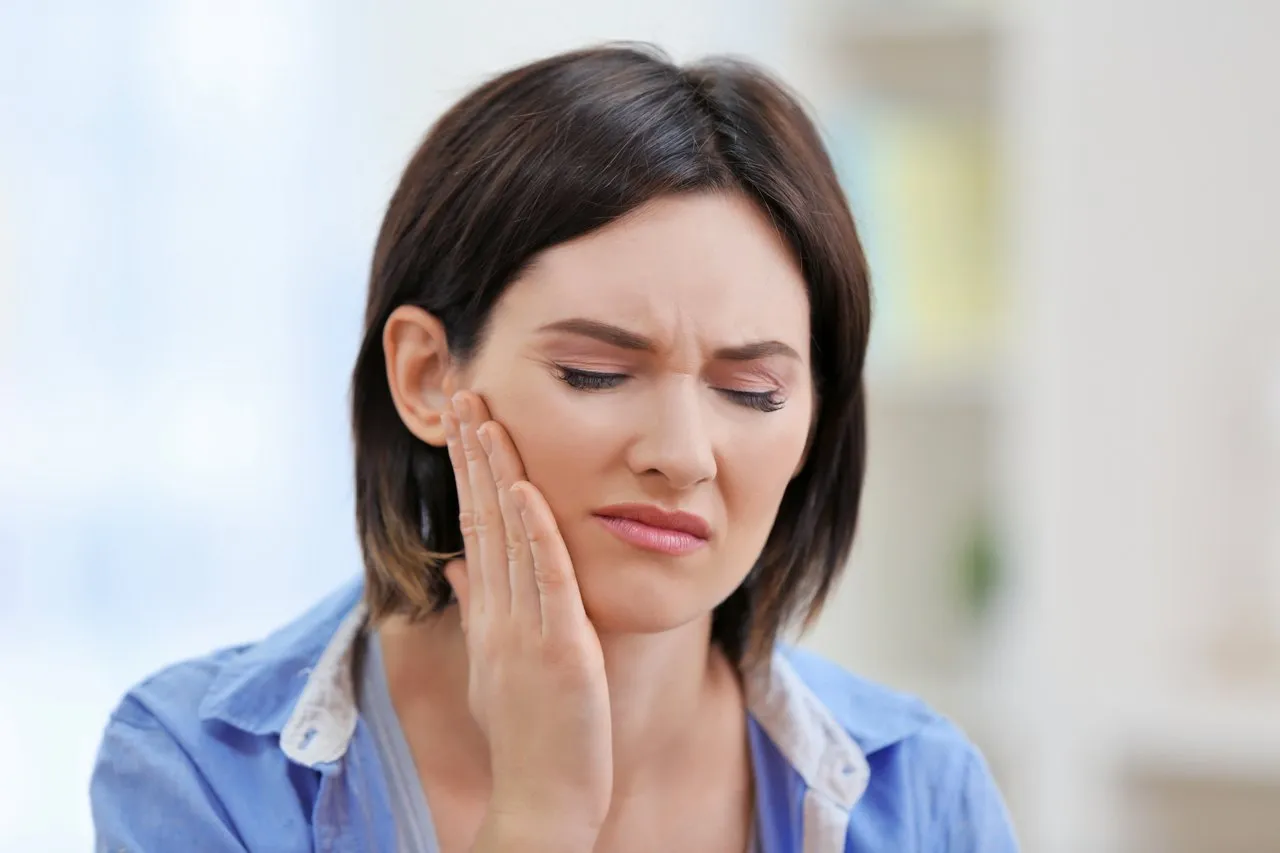
A sip of ice water, a breath of cold air, a spoonful of ice cream – and a short, sharp pain shoots through the tooth. It disappears again after a few seconds. In dentistry, this is called dentine hypersensitivity, literally oversensitivity of the dentine. Around 25 to 30 per cent of adults are familiar with this twinge, most commonly between the ages of 30 and 40. The pain does not originate in the enamel, but one layer beneath it, in the dentine. This page first explains why a trigger causes pain there at all, then which active ingredients have been shown to help in studies – and, above all, how to tell when something other than simple sensitivity is behind the twinge. This distinction is precisely what determines whether you need a different toothpaste or an appointment.
Über 350 Google-Bewertungen
Why a trigger causes pain at all
A tooth consists of enamel on the outside, the hardest tissue in the body, and dentine beneath it. Dentine is not a solid block. It is permeated by thousands of microscopic tubes, the dentinal tubules, which run from the interior of the tooth to the surface and are filled with fluid. Nerve fibres are located at the ends of these tubules, in the dental pulp. As long as enamel or gum covers the dentine, nothing happens. If it is exposed and the tubules are open to the oral cavity, this changes. Cold, heat, sweet or acidic substances, or touch set the fluid in the tubules in motion. This movement stimulates the nerve fibres, and the brain registers pain.
This is the hydrodynamic theory, developed by Martin Brännström, described comprehensively in 1972 and still the accepted explanatory model today. A study by Absi, Addy and Adams from 1987 shows just how strong the connection is: they tested teeth for sensitivity before extraction and then examined them under a scanning electron microscope. Around eight times as many tubules were open in the hypersensitive areas as in the non-sensitive areas, and their diameter was approximately twice as large. Everything else on this page follows from this. There are exactly two ways to influence the pain: seal the tubules or dampen the nerve response. Everything else addresses the underlying cause.
Sensitivity is a diagnosis of exclusion
One point is easily overlooked, yet it is the most important. The commonly used definition is: dentine hypersensitivity is pain arising from exposed dentine, typically in response to external stimuli, which cannot be explained by another dental disease. The last part is not a formality, but the crux of the matter. Sensitivity is a diagnosis of exclusion: it can only be confirmed once tooth decay, a crack in the tooth, a leaking filling, inflammation of the dental pulp and inflammation at the root tip have been ruled out.
In practical terms, this means that short pain lasting exactly as long as the trigger and affecting several teeth on the same side points towards sensitivity. Pain that lingers after the trigger, occurs spontaneously, wakes you at night, can be pinpointed to a single tooth, or occurs when biting down and releasing points away from it. It should be investigated – not because every one of these situations is dramatic, but because a sensitive toothpaste will do nothing to resolve them and time will be lost. The next section distinguishes between the five presentations.
Distinguishing between five types of pain
The following overview is no substitute for an examination – it is intended to help you describe the right details when you are in the dental chair. Pay particular attention to three things: how long the pain persists after the trigger, whether it can be pinpointed to a single tooth and whether it occurs when biting down.
Brief pain triggered by a stimulus, ending when the stimulus ends
The classic picture of dentine hypersensitivity. The pain starts with cold, sweet or acidic substances, or touch, is sharp and brief, and stops immediately. It usually affects several teeth, particularly on the cheek-facing surfaces and more often in the upper jaw. Active ingredients and protective measures can help here.
Pain that lingers after the trigger
If the pain lingers for seconds to minutes after the stimulus, occurs spontaneously or wakes you at night, this points to inflammation of the dental pulp, known clinically as pulpitis. The tooth can then usually be identified precisely. This calls for an appointment, not a different toothpaste.
Pain that responds much more strongly to sweet substances than to cold, in a single tooth
Sweet substances are also a classic trigger for dentine hypersensitivity, because sugar draws water osmotically from the fluid in the tubules and thereby sets it in motion. However, if pain in response to sweet substances is concentrated on a single tooth or a specific spot, tooth decay must first be ruled out – particularly at the neck of the tooth and around the edges of fillings.
Pain when biting down and releasing
This is the cardinal symptom of a crack in the tooth. In an analysis of 107 teeth with longitudinal cracks, 82.2 per cent were sensitive in a bite test; 72.0 per cent of these teeth already had a filling or crown. An important point for context: in a general dental practice, 55.1 per cent of teeth with cracks were completely symptom-free, and not every cracked tooth responds to the bite test. A negative test therefore does not rule out a crack.
Pain on pressure and touch in one tooth, often with tenderness to tapping
If a tooth responds to pressure from above and to tapping, the stimulus no longer comes from the dentinal tubules, but from the supporting tissues – for example, due to inflammation at the root tip or a contact point that is too high after a filling. A tooth that feels ‘too high’ when you bite down should be checked; a contact point that is too high can be corrected in a few minutes.
Why the neck of the tooth is particularly unprotected
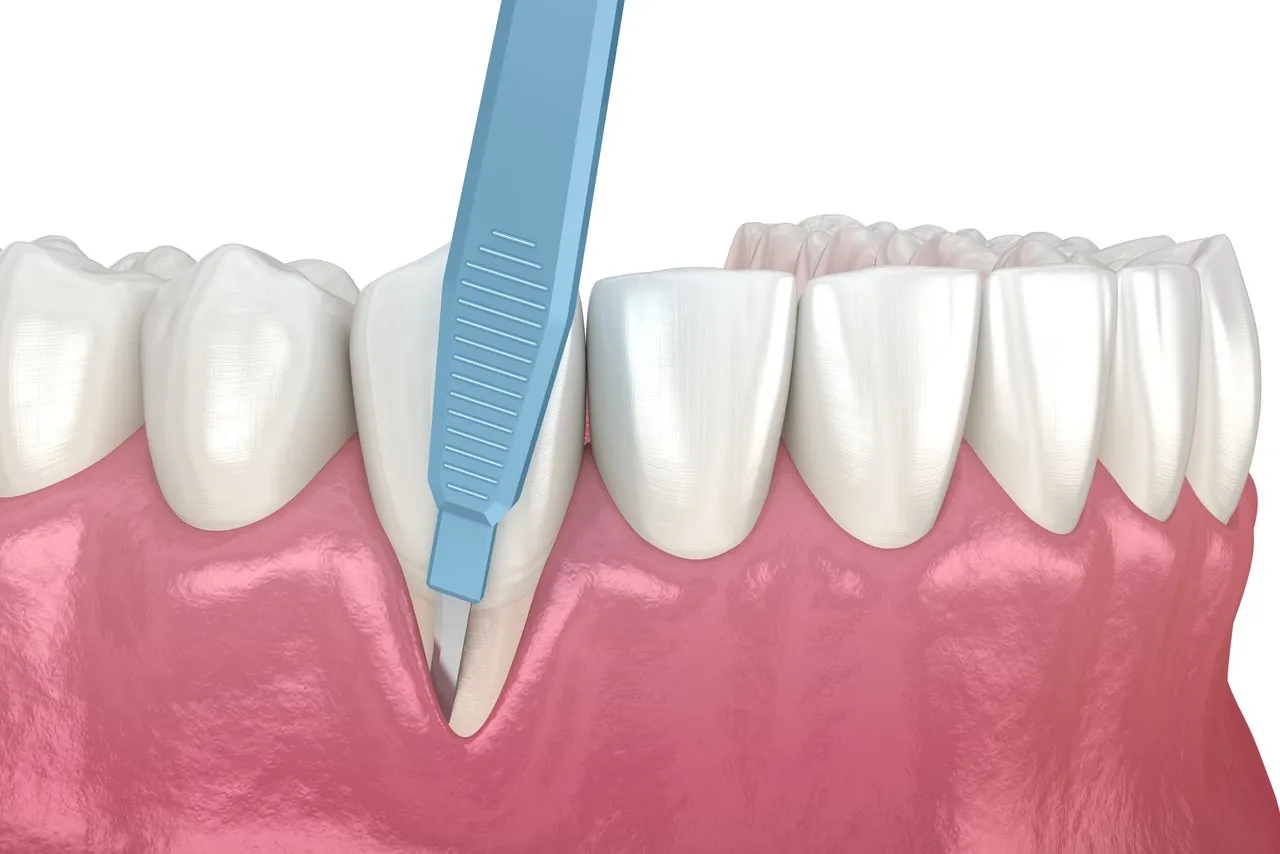
Two tissues meet at the neck of the tooth: the enamel, which covers the crown, and the root cementum, which covers the root. This junction is called the cementoenamel junction. The root cementum is considerably thinner and softer than enamel – it is not designed to be exposed in the mouth, but to be embedded in bone. When the gums recede, this is precisely the zone that is exposed first. The cementum is worn away comparatively quickly by brushing and acid, immediately exposing the underlying dentine, whose tubules then open directly into the oral cavity. This explains why sensitivity so often begins at the neck of the tooth rather than on the chewing surface.
It also explains why sensitivity occurs more frequently after periodontitis treatment: as the inflammation subsides, the gums shrink back and expose root surfaces that were previously covered. The epidemiological review by Splieth and Tachou identifies precisely this combination – periodontal treatment followed by more intensive brushing – as one of the situations with a particularly high rate of sensitivity. This is not a setback, but visible evidence that the treatment has worked. It simply means that a second step is needed afterwards.
What exposes dentine
Two things must happen for sensitivity to develop: the dentine must be exposed and the tubules must be open. The following processes cause one, the other or both. In most cases, several act together.
Gum recession
The most common way in which root surface becomes exposed. Causes include periodontitis, thin gums, misaligned teeth and piercings. The evidence on the role of brushing technique is less clear-cut than is often claimed – the section after next addresses this.
Erosion caused by acid
Acid dissolves minerals from tooth enamel and exposed root cementum. A meta-analysis from Göttingen covering 71 studies found clear associations with regurgitation of stomach acid (odds ratio 2.27), acidic foods (2.40), digestive disorders (1.81), food supplements (1.73) and carbonated drinks (1.43). Acid is also the substance that opens the tubules themselves.
Abrasion caused by grinding and clenching
When teeth rub against each other, enamel is lost from the chewing surfaces and biting edges; this is known clinically as attrition. Once the enamel has worn through in an area, dentine is exposed. A dedicated S3 guideline on the diagnosis and treatment of bruxism has been available since January 2026.
Tooth decay at the neck of the tooth and around filling margins
Tooth decay destroys enamel and exposes dentine, but has its own pain pattern and requires its own treatment. The risk is particularly high on exposed root surfaces – a dedicated section below covers this.
Cracks in the tooth
A fine longitudinal crack allows fluid to reach deeper layers of the tooth directly. Pain when biting down and releasing is typical; restored teeth are affected considerably more often.
Recently treated teeth
A tooth may be temporarily more sensitive after a filling, crown or dental cleaning. Figures on how common this is and how long it normally lasts are provided below.
‘Brushing too hard’ – what the evidence actually shows
Brushing too hard with a hard-bristled toothbrush is widely considered to be the main cause. The evidence is not so clear-cut. A systematic review by Rajapakse and colleagues from 2007 assessed 18 studies examining whether toothbrushing causes or advances gum recession. Of the 17 observational studies, eight found an association with brushing frequency and two found none; not a single one met all the review's quality criteria. The authors' conclusion was literally that the data were “inconclusive”. The same applies to the tooth itself: according to Martin Addy's assessment, brushing with or without toothpaste in the absence of acid causes only minimal enamel loss.
The combination is decisive. Acid softens the surface, and only the subsequent mechanical stress wears it away; together, abrasion and dietary acid can open the tubule system. For you, this means something other than “brush more gently”. It means: do not brush immediately after anything acidic, and reduce the number of acid exposures throughout the day. A soft toothbrush and little pressure are still sensible, but they are not the single lever they are usually sold as.
What is actually checked during the examination
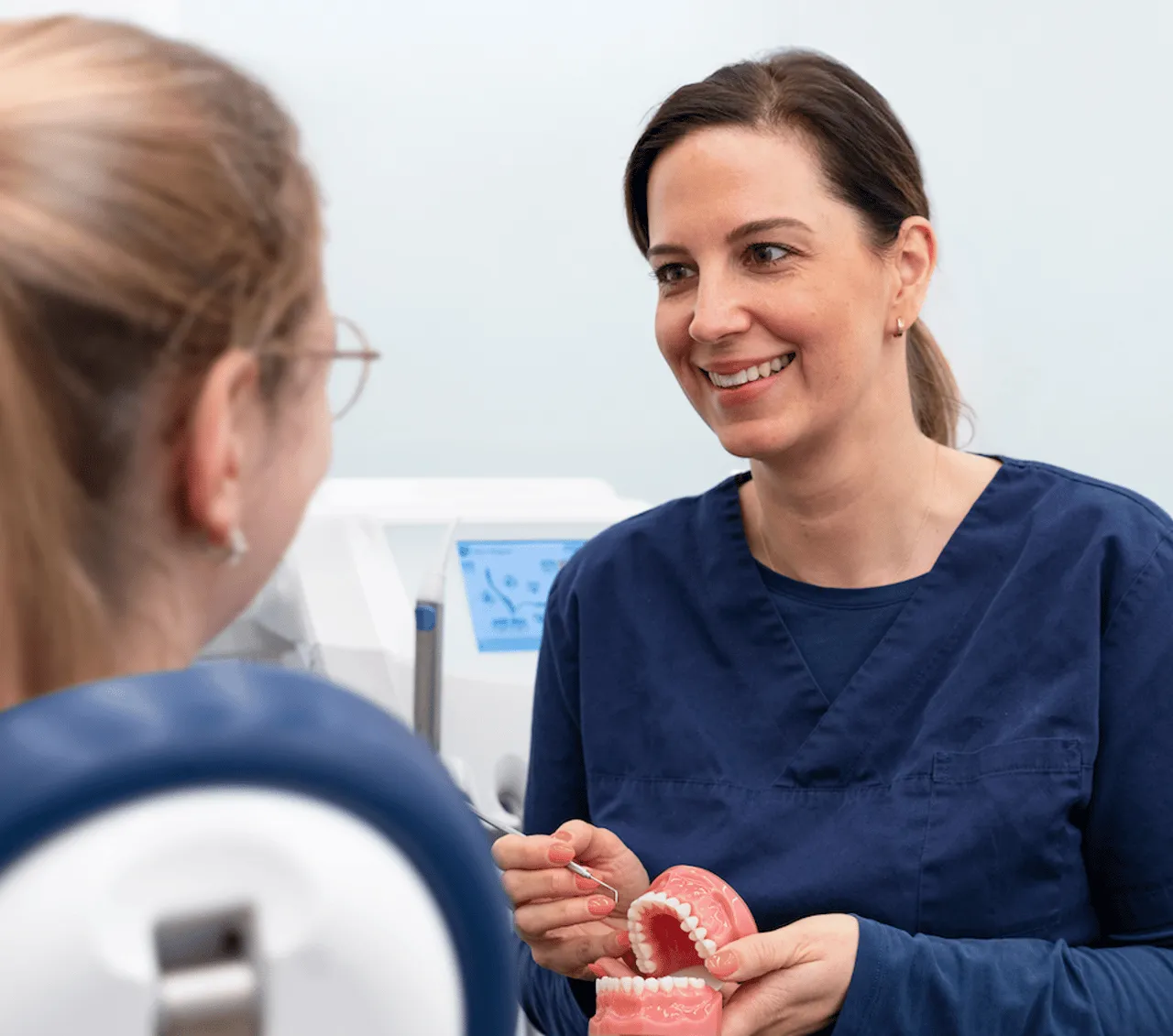
‘Special tests’ says very little – so here are the steps actually involved. First, the medical history: which trigger causes the pain, how long does it persist after the trigger, can it be pinpointed to one tooth, is there pain at night, what is your diet like, do you grind your teeth, and do you experience heartburn or acid regurgitation? Second, the targeted stimulus test: a blast of air from the dental unit onto the isolated, dried surface at the neck of the tooth and carefully running a probe along it stimulate precisely the tubules in question.
Third, the cold test compared with neighbouring teeth – the fee schedule calls this ‘vitality testing of one or more teeth, including a comparison test’: the suspect tooth is tested against a healthy neighbouring tooth, because only the comparison is meaningful. The decisive factor is not whether it hurts, but whether the pain persists after the stimulus is removed. Fourth, the bite test: you bite down specifically on an individual cusp and then release. Fifth, the percussion test, which checks the supporting tissues. These are supplemented by checks of filling margins and contact points, a periodontal assessment and, where necessary, an X-ray. Only once everything else has been ruled out can dentine hypersensitivity be diagnosed.
Two mechanisms of action – there are no others
The mechanism gives rise to two targets, and every toothpaste for sensitive teeth works according to one or both of them. The first is occlusion of the dentinal tubules: the active ingredient forms a layer of sparingly soluble crystals on the exposed surface and at the openings of the tubules. If the fluid no longer moves, no stimulus is generated. Stannous fluoride, arginine combined with calcium carbonate, hydroxyapatite, strontium salts and calcium sodium phosphosilicate work according to this principle. The second approach is to dampen the nerve response: potassium ions increase the potassium concentration around the nerve fibre and make it harder for the nerve to trigger a signal. Potassium nitrate works according to this principle. The difference is relevant in practice.
Tubule occlusion works at the site and can be worn away again by acid – which is why toothpaste is of little use while the source of acid remains. Nerve dampening takes time: in the studies, the effect was typically measured after four to eight weeks of twice-daily use, not after two days. Anyone who sets aside a toothpaste for sensitive teeth after a week as ineffective has not used it for long enough. The next section shows how well each active ingredient performed against each stimulus. Our page on toothpaste for sensitive teeth explains which products contain these substances and what to look for when buying and using them.
How the active ingredients compare
The following figures come from a network meta-analysis published in the Journal of Dental Research in 2020, which combined 125 randomised studies with 12,541 patients. The standardised mean difference compared with an ordinary fluoride toothpaste is shown, with the 95 per cent interval in brackets. The larger the value, the greater the measured difference; the narrower the interval, the more certain the finding. If the interval extends close to zero, the effect is uncertain. None of these figures guarantees an outcome in an individual case, and which substance is suitable for you depends on the clinical findings.
Stannous fluoride – sealing the tubules
For tactile stimulation, 2.02 (1.06 to 2.99); for air blast, 1.90 (1.03 to 2.77), each with moderate to high certainty of evidence. Stannous fluoride is therefore one of the active ingredients for which both major network meta-analyses – the one from 2020 and the 2023 analysis from Bristol – consistently issue a recommendation.
Potassium plus stannous fluoride – both principles combined
The largest single effect in the entire analysis for tactile stimulation: 3.05 (1.69 to 4.41); for air blast, 2.28 (0.87 to 3.69). The combination acts on the tubules and the nerve simultaneously.
Arginine with calcium carbonate – sealing the tubules
For air blast, 2.22 (1.45 to 2.99), with moderate to high certainty. Arginine is not among the substances with a large effect for tactile stimulation. The 2023 Bristol analysis also identifies arginine as recommendable.
Potassium nitrate alone – nerve dampening
1.23 (0.48 to 1.98) for tactile stimulation, the weakest of the effective substances in this analysis. A 2006 Cochrane review of six studies did find a significant effect on air-blast and tactile stimulation after six to eight weeks, but no significant effect in patients’ own subjective assessments – and concluded that there was no clear evidence for potassium toothpastes. This qualification is an important part of the picture.
Hydroxyapatite – sealing the tubules
Combined with potassium, 2.47 (0.30 to 4.64) for tactile stimulation and 2.44 (0.33 to 4.55) for air blast. Both intervals extend close to zero, so the finding is correspondingly uncertain. Hydroxyapatite alone does not appear among the substances with a demonstrated individual effect in the 2020 analysis, and the 2023 Bristol analysis does not list it among the recommended formulations. This does not mean that it does not work – it means that the evidence is weaker than for stannous fluoride and arginine.
Calcium sodium phosphosilicate – sealing the tubules
The only substance with a large demonstrated effect for all three stimuli tested: cold 3.93 (0.34 to 7.53), touch 2.14 (0.75 to 3.53), air blast 1.98 (0.99 to 2.98). However, the interval for the cold stimulus is very wide.
What can be done at the practice – and what it costs
The German Dental Fee Schedule (GOZ) has a specific item for treating hypersensitive tooth surfaces: item 2010, ‘Treatment of hypersensitive tooth surfaces, per jaw’, valued at 50 points. At the 2.3 multiplier, which under Section 5(2), sentence 4 GOZ reflects an average service, this amounts to €6.47 per jaw; without a special agreement, the fee schedule ranges from the single rate to 3.5 times that rate, i.e. from €2.81 to €9.84. The fee schedule generally covers the application of a varnish or solution that seals the tubules. If this is insufficient, sealing the exposed surface may be considered – item 2000 explicitly also includes sealing of smooth surfaces, 90 points, amounting to €11.64 per tooth at the 2.3 multiplier.
If the neck of the tooth is not only sensitive but already defective, a filling is required; a single-surface composite filling using adhesive techniques is listed as item 2060 with 527 points, amounting to €68.17 per tooth at the 2.3 multiplier. Depending on the findings, treatment of the underlying causes may also be required: correcting a contact point that is too high, treating tooth decay, periodontal therapy or a splint for grinding. A rate above 2.3 is only permissible if particular difficulty, time required or circumstances of delivery justify it, and a clear written justification for the individual service must appear on the invoice; conversely, services that are less difficult or time-consuming than average must be charged at a lower rate.
The 3.5 multiplier is the limit set by the fee schedule, but not an absolute cap: the dentist and the person liable for payment can agree a different fee – following a personal discussion in the individual case, before treatment and in writing, stating the number and description of the service, the agreed multiplier, the resulting amount and a note that reimbursement by reimbursing bodies may not be guaranteed in full; you receive a copy of this agreement. Two limits apply without exception: emergency and acute pain treatment must not be made conditional on such an agreement, and only the multiplier can be agreed – a different number of points or point value is not permitted.
Which items apply in your case depends on the clinical findings and is set out in your treatment and cost plan; under Section 630c(3) of the German Civil Code (BGB), you must receive the anticipated costs in text form before treatment begins if payment by a third party is not assured. To be fully transparent, the evidence for professionally applied products is weaker than for toothpastes. The major review by West, Seong and Davies assessed eleven active ingredients and 105 randomised studies in 2015 and concluded that there was only limited evidence for the relative effectiveness of individual professionally applied products.
Exposed tooth necks are more than a comfort issue
When root surface is exposed, the concern is not only sensitivity but also the risk of tooth decay. Root surfaces are softer than enamel and begin to dissolve at a less acidic pH. The current S3 guideline ‘Caries prevention in permanent teeth’, issued by the German Society for Conservative Dentistry and the German Society for Dentistry, Oral and Maxillofacial Medicine and listed in the AWMF register under number 083-021, issued several recommendations for this situation in January 2025. According to the guideline, fluoride varnishes should also be considered for adults at increased risk of root surface caries – recommendation grade A, the strongest level, adopted by strong consensus and based on the highest level of evidence. The same recommendation grade A applies to fluoride gels, albeit based on a weaker level of evidence.
The guideline issues a grade B recommendation for fluoride mouth rinses, explicitly with regard to the root surface. And a more highly concentrated fluoride toothpaste should be used permanently to prevent root surface caries; in Germany, it is prescription-only and only approved from the age of sixteen, so it belongs in the hands of a dentist rather than on the shelves of a chemist. The guideline and fee schedule give the same answer on how often fluoridation is advisable: the guideline relies on data showing that quarterly fluoride varnish treatment reliably reduces caries in people at increased risk of root caries, and the fee schedule permits item 1020 exactly four times a year. At the 2.3 multiplier, this amounts to €6.47 per session and €25.88 per year.
Sudden sensitivity – what needs to be clarified first
Dentine hypersensitivity normally develops slowly, over months and years, because gum recession and loss of tooth substance also occur slowly. If a tooth or group of teeth suddenly becomes sensitive, this is therefore a distinct signal and not a reason simply to change toothpaste. Four groups of causes are particularly relevant. First, recent treatment: a filling, crown, dental cleaning or whitening. Figures are available for this and appear in the next section. Second, an acute acid event – a gastrointestinal illness with vomiting, a period of severe heartburn, or a change in diet involving large amounts of fruit, juice or vinegar.
Third, a crack or fracture, often after biting on something hard; pain when biting down and releasing is then typical. Fourth, incipient inflammation of the dental pulp, recognisable by pain that persists after the trigger, occurs spontaneously or arises at night. The short answer is therefore: sudden onset points away from classic sensitivity and towards one of the four causes listed. Have it examined before masking it.
Sensitivity after a filling, crown or dental cleaning
It is common for a tooth to be more sensitive for a while after treatment, and this is generally temporary. How common it is has been investigated. In a double-blind randomised study of 72 participants with 236 composite fillings, the risk of spontaneous sensitivity after the procedure was 20.3 per cent, and it typically occurred within 48 hours; neither the type of bonding agent nor the filling technique made a difference. A second randomised study of 55 participants with 220 fillings found spontaneous sensitivity in 40.0 per cent within the first seven days – and after twelve months, nobody reported it any more. Two conclusions follow. Firstly, days to a few weeks is the normal course. Secondly, anything that does not improve after several weeks, gets worse or occurs at night needs to be checked.
The most common treatable cause is a contact point that is too high, which can be corrected in a few minutes. The same framework applies after a professional dental cleaning, and one detail is worth mentioning: the subsequent fluoride treatment is already included in the dental cleaning service. The fee schedule explicitly lists “suitable fluoridation measures” under item 1040 in the service description and stipulates that the separate fluoridation item 1020 cannot be charged in addition. If the dental cleaning is billed under this item, fluoridation is therefore included in the service and does not appear as a separate line item. What is charged in your case is shown on your invoice – if in doubt, ask about it.
Menopause, vitamins and other common assumptions
Two assumptions come up particularly often on this subject: that the menopause is to blame and that a vitamin deficiency is behind it. Both deserve an honest answer rather than silence. On the menopause: no direct link between oestrogen deficiency and dentine hypersensitivity has been demonstrated. There is, however, a plausible chain for which data exist. A 2026 review bringing together fifty studies on oral health across the menopausal transition reports poorer periodontal measurements, including attachment loss, reduced salivary flow, dry mouth and burning. Less saliva means less rinsing, less buffering of acid and fewer minerals available for replenishment; attachment loss means exposed root surface. These are precisely the conditions under which sensitivity develops.
Another important piece of context is that dentine hypersensitivity peaks between the ages of 30 and 40, before the typical age of menopause. On vitamin deficiency: there is no robust evidence of a link between vitamin deficiency and sensitive teeth. The vitamin deficiency with well-documented effects in the mouth is vitamin C deficiency, and it shows in the gums – swollen, red and bleeding – not as stimulus-induced pain in a tooth. Bleeding gums are a reason to make an appointment. Incidentally, food supplements have tended to emerge as a risk in erosion research: in the Göttingen meta-analysis, the odds ratio for erosive loss of tooth substance was 1.73. Acidic effervescent tablets and chewable preparations have a low pH.
Grinding as a cause – in brief
Grinding and clenching cause the teeth to rub against each other and lose enamel from the chewing surfaces and biting edges. Once the enamel has worn through in an area, dentine is exposed, creating the conditions for sensitivity. A dedicated S3 guideline on diagnosis and treatment has been available since January 2026, and we have a dedicated page on the splint, the role of stress and distinguishing this from temporomandibular joint problems – it covers these topics in detail.
What you can do yourself
These points are no substitute for identifying the cause, but they address the factors within your control. Which of them are advisable in your case depends on the clinical findings.
Do not brush immediately after consuming acidic food or drink
The most effective individual step, because it breaks the demonstrated combination of acid and abrasion. After fruit, juice, soft drinks, wine or vinegar, rinse with water first and wait a while before reaching for your toothbrush.
Choose toothpaste by active ingredient, not packaging
Check the back of the pack for stannous fluoride, arginine or potassium nitrate – these are the substances with the strongest evidence. According to the S3 guideline, the toothpaste should always contain fluoride, at least 1,000 ppm; this is also stated on the packaging.
Give the toothpaste time
In studies, the effect was typically measured after four to eight weeks of twice-daily use. Anyone who switches after a week is not measuring anything.
Soft brush, light pressure – but without false expectations
Advisable because this protects root cementum and acid-softened surfaces. Not advisable as the only measure: the systematic review examining whether brushing causes gum recession explicitly reaches no conclusive result.
Reduce the number of acid exposures, not just the quantity
For the tooth, what matters is how often the pH falls, not the total amount consumed. A diluted fruit juice sipped throughout the morning is more harmful than the same glass drunk in five minutes.
Have heartburn assessed by a doctor
Regurgitation of stomach acid was one of the strongest individual factors for erosive loss of dental hard tissue in the Göttingen meta-analysis, with an odds ratio of 2.27. This is a matter for your GP, not your toothbrush.
When you should not wait
Sensitive teeth are usually a comfort issue and rarely an emergency. However, there are patterns where waiting is the wrong approach, and they can all be summed up in one sentence: the pain no longer behaves like stimulus-induced pain. Specifically, this means the pain persists after the trigger instead of stopping immediately. It occurs spontaneously, without you having consumed anything cold or sweet. It wakes you at night. It can be pinpointed to a single tooth.
It occurs when biting down and releasing. There are also signs that warrant an appointment in any case: a visible defect, a broken-off piece, swelling, bleeding gums or sudden onset without an apparent reason. None of these necessarily means anything serious. It means that toothpaste would be the wrong response. And if the sensitivity really is just sensitivity, that is good news: the cause can then generally be addressed effectively and treatment is manageable.
Frequently asked questions about sensitive teeth
This is the most important question of all, because the answer distinguishes between diagnoses. With dentine hypersensitivity, the pain is short and sharp and ends with the stimulus. If it persists for seconds or minutes afterwards, occurs spontaneously or wakes you at night, this points to inflammation of the dental pulp. Pay conscious attention to this next time and describe it at your appointment – it can avoid detours.
There are two mechanisms of action: sealing the dentinal tubules or dampening the nerve response. A 2020 network meta-analysis of 125 randomised studies with 12,541 participants compared the active ingredients. Stannous fluoride, stannous fluoride combined with potassium and arginine had the largest and most certain effects; potassium nitrate alone performed most weakly, and a 2006 Cochrane review even concluded for potassium that there was no clear evidence. Fluoride should always be included, at least 1,000 ppm according to the S3 guideline. And in the studies, measurements were taken after four to eight weeks, not after one week.
No – at least not if it really is dentine hypersensitivity. The definition explicitly excludes tooth decay: it is pain from exposed dentine that cannot be explained by another dental disease. Before the diagnosis can be confirmed, tooth decay, a crack, a leaking filling and inflammation must be ruled out. Conversely, if the pain can be pinpointed to a single tooth, responds much more strongly to sweet substances than to cold, or lingers, tooth decay must first be ruled out. This is why sensitivity in several teeth at once is more reassuring than worrying.
Cleaning also removes deposits from exposed root surfaces; in the short term, the surface is then more exposed. This usually settles within a few days. Subsequent fluoridation is not a separate charge if the cleaning is billed under the item for professional dental cleaning: the fee schedule explicitly lists ‘suitable fluoridation measures’ in that service description and stipulates that the separate fluoridation item cannot be charged in addition. If the sensitivity persists for weeks, please contact us.
No direct link has been demonstrated. What has been demonstrated is an indirect route: a review of fifty studies on oral health during the menopausal transition reports reduced salivary flow, dry mouth and poorer periodontal measurements, including attachment loss. Less saliva means less protection against acid, and attachment loss means exposed root surface – both are conditions for sensitivity. At the same time, dentine hypersensitivity peaks between the ages of 30 and 40, before this stage of life. If sensitivity develops during this phase, it is more useful to look at the gums and dry mouth than at hormone levels.
There is no robust evidence for this. The vitamin deficiency with well-documented effects in the mouth is vitamin C deficiency, and it shows in the gums – swollen, red and bleeding – not as stimulus-induced pain in a tooth. Bleeding gums are a reason in themselves to make an appointment. Incidentally, acidic food supplements were more of a risk factor than a form of protection in a meta-analysis of erosive loss of dental hard tissue.
Book your appointment now
We would be happy to advise you in person at our practice.