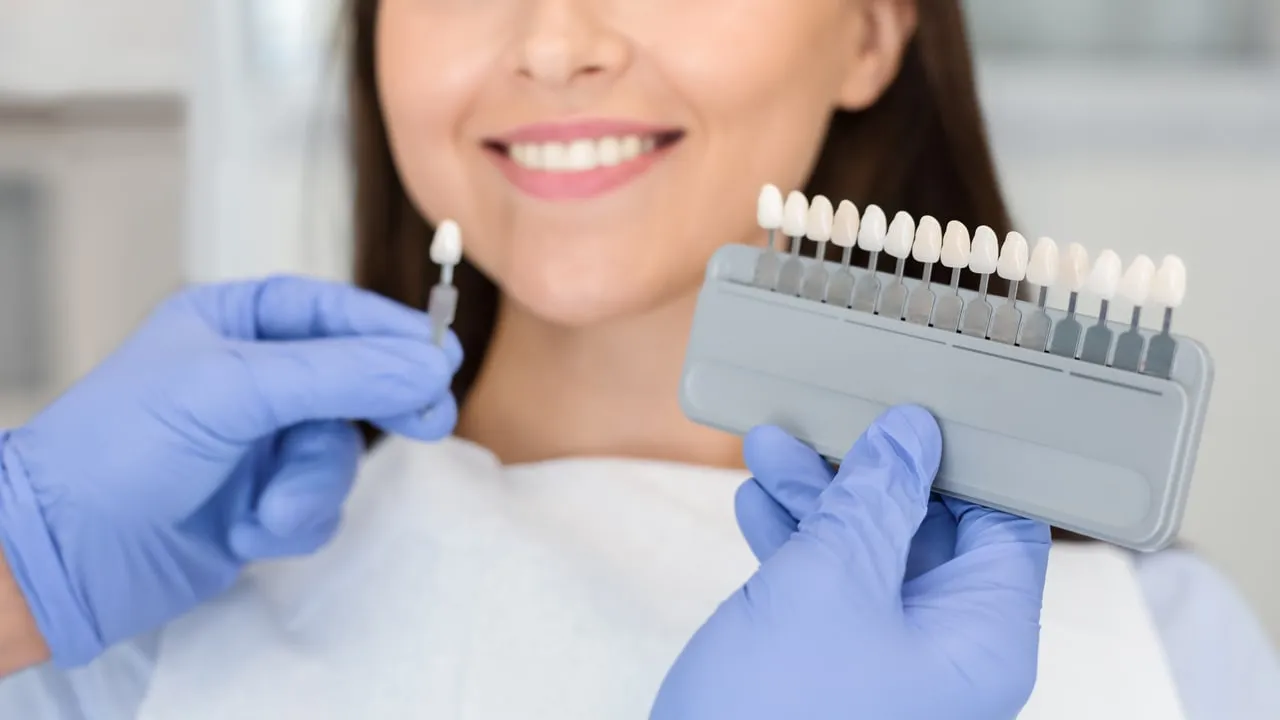
Dental bonding: correcting tooth shape directly with composite
For dental bonding, the dentist applies tooth-coloured composite material directly to the tooth, shapes it in the mouth and hardens it with light. This can close a small gap between the incisors, rebuild a chipped corner or widen a tooth that is too narrow. No impression or laboratory work is needed, and no temporary restoration either. The technical dental term for this is direct tooth-shape correction with composite. On this page, you will find out how the treatment works, what the current S3 guideline recommends, how the price is calculated under the German Scale of Fees for Dentists (GOZ) and when statutory health insurance will contribute.
Über 350 Google-Bewertungen
What dental bonding is – and how it differs from other treatments
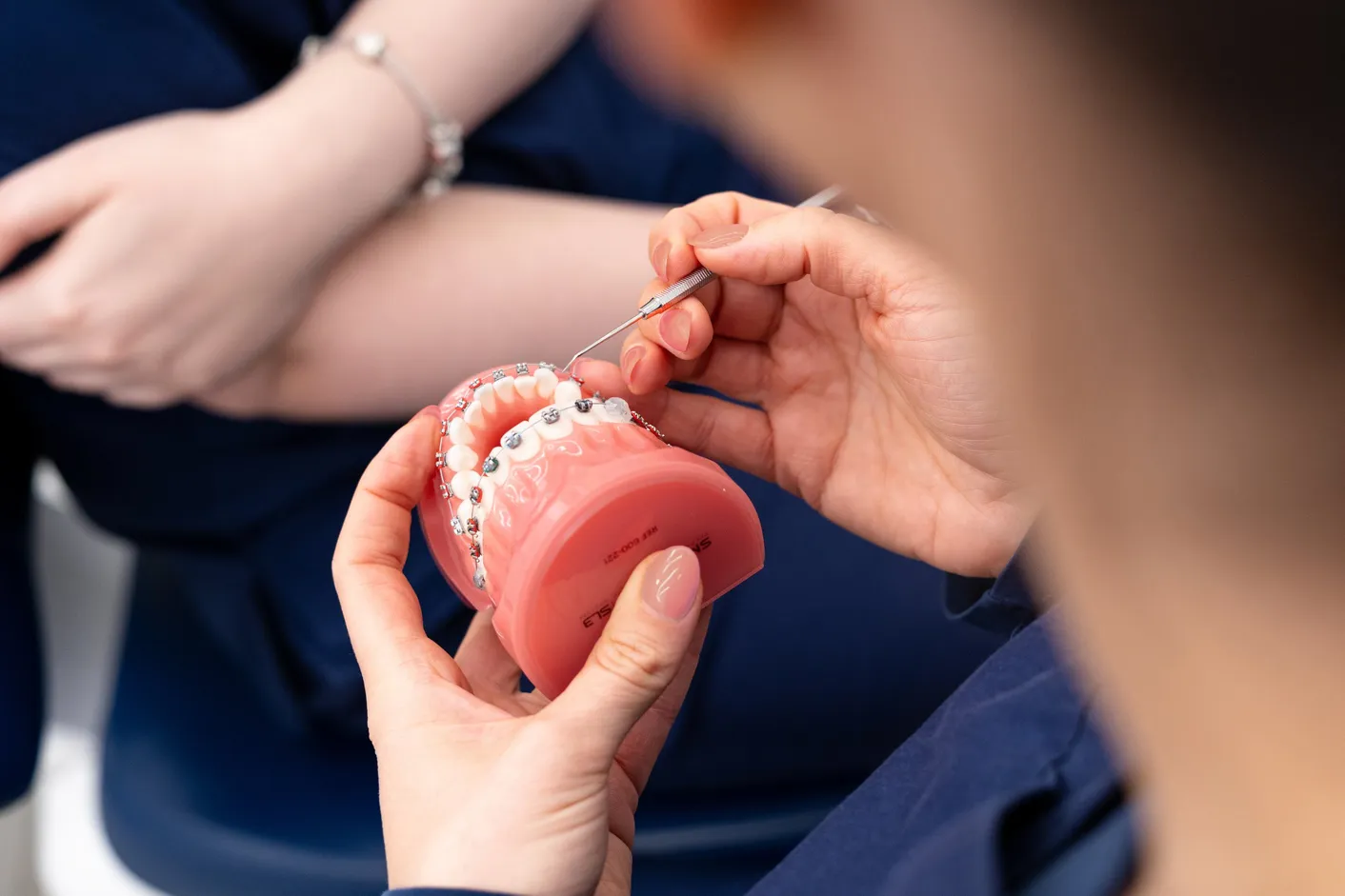
In English, bonding simply means joining or connecting, and in dentistry it describes the bonding of material to tooth enamel. The term is used for two completely different treatments, which is exactly why many searches go wrong. In orthodontics, bonding means attaching brackets, aligner attachments or retainers – the aim is tooth movement, not appearance. With dental bonding in the aesthetic sense, by contrast, composite material is built up in several layers on the visible tooth to change its shape or colour. The S3 guideline includes tooth reshaping, correction of tooth position, gap closure, tooth widening and tooth-colour correction in the front teeth. The only thing they have in common is the adhesive technique. The enamel is conditioned, a bonding agent is applied and the material is light-cured. Everything else – the aim, procedure, duration and billing – is different.
When dental bonding may be suitable
Closing a gap between the incisors
A visible gap between the central incisors, known clinically as a diastema, can be closed visually by adding composite to both sides. The S3 guideline explicitly mentions gap closure.
Tooth widening and reshaping
A tooth that is too narrow or has an unusual shape can be matched to the neighbouring teeth by building up composite; the guideline lists tooth reshaping and tooth widening as indications in their own right.
Chipped incisal edge
After an accident or fracture, the missing corner can be rebuilt directly. The 2017 study by Lempel and colleagues cited by the guideline examined precisely this group: fractured upper front teeth and gap closures.
Tooth-colour correction on individual teeth
If an individual tooth differs markedly in colour, the guideline mentions tooth-colour correction with composite as an option. For whitening all teeth, teeth whitening is the other option.
Worn front teeth
For worn front teeth, studies by Poyser and Al-Khayatt provide follow-up data for up to seven years, with survival rates of 85 per cent. Beforehand, we will establish whether the wear first needs to be investigated for an underlying cause, such as teeth grinding.
Cervical defects at the gum line
Wedge-shaped defects at the tooth neck fall into restoration class V, which has its own chapter in the S3 guideline. Unlike a purely shape-related correction, such a defect usually constitutes a disease, and this changes whether the costs are covered.
What the current guideline says about bonding
Since January 2024, there has been a dedicated S3 guideline on this subject: ‘Direct composite restorations on permanent teeth in the anterior and posterior regions’, issued by the German Society for Conservative Dentistry and the German Society for Dental, Oral and Maxillofacial Medicine, and listed in the AWMF register under 083-028. S3 is the highest development level for a medical guideline in Germany. Its recommendation 9 states verbatim: direct composite materials should be used for tooth-shape corrections in the front teeth. This recommendation carries grade A, the strongest level. The guideline group adopted it unanimously by 16 votes to 0 with strong consensus. The associated recommendation 10 adds that, whenever possible, direct procedures that preserve hard tooth tissue should be preferred for tooth-shape correction in the front teeth, and that indirect ceramic veneers can be used as an alternative. However, the guideline also says that these are often elective procedures. It also states that practitioners must have a high degree of technical skill to carry out direct tooth-shape corrections. Both points are part of an honest account of the treatment.
What happens during a bonding appointment
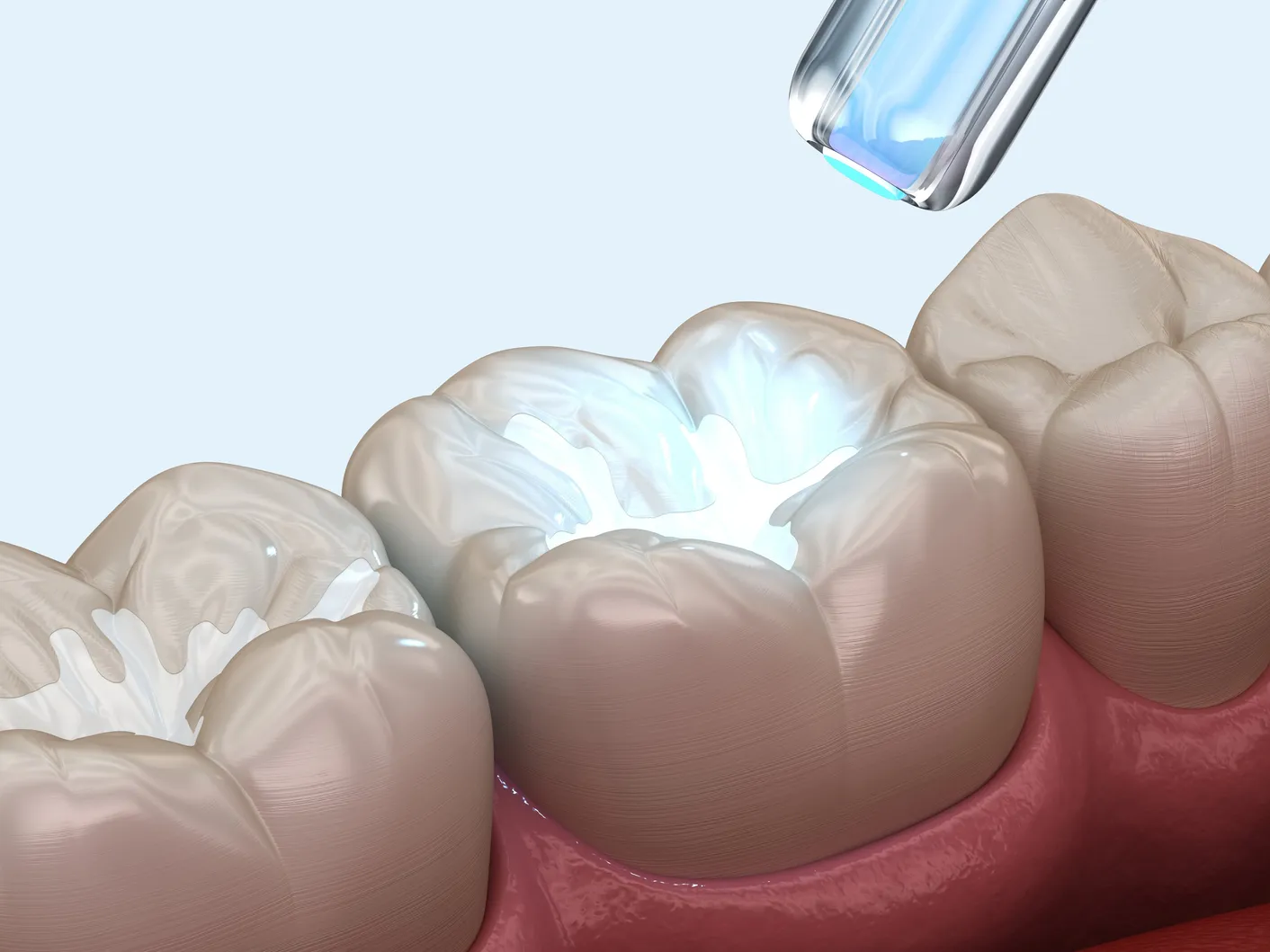
It begins with a thorough examination. Before any cosmetic correction, it must be established whether the teeth and gums are healthy and whether an underlying cause such as tooth decay, teeth grinding or misalignment is responsible. We then discuss shape and colour and record the planned services in a written treatment and cost plan. During the treatment itself, the tooth surface is cleaned and kept dry, often with a rubber dam, because moisture interferes with the adhesive bond. The enamel is then conditioned, the bonding agent applied and the composite built up in several layers, each of which is light-cured. Finally, the shape is refined and the surface polished. The bite is also checked. Because no impression or dental laboratory is involved, a second appointment and temporary restoration are usually unnecessary. The fee schedule includes a separate item for a later check and repolishing.
Dental bonding costs: how the amount is calculated
Cosmetic shape correction is a private treatment and is billed under the German Scale of Fees for Dentists (GOZ). The price is made up of three elements: the fixed number of points for the relevant fee item, the statutory point value of 5.62421 cents under § 5(1) GOZ, and the multiplier between 1.0 and 3.5, which the practice determines at its reasonable discretion based on difficulty, time required and the circumstances in which the treatment is carried out (§ 5(2), sentence 1 GOZ). For composite restorations using adhesive technique, the fee schedule lists item numbers 2060 to 2120, graded by the number of surfaces treated: 527 points for one surface, 556 points for two surfaces, 642 points for three surfaces and 770 points for more than three surfaces. At the 2.3 multiplier, which under § 5(2) GOZ represents an average service, this works out at €68.17, €71.92, €83.05 and €99.60 per tooth respectively. The full range under the fee schedule is €29.64 to €151.57 per tooth. Which items apply in your case depends on the findings and the extent of treatment, and will be listed in your treatment and cost plan. Depending on the case, examination, planning, isolation and a later follow-up appointment may also apply. That is why this page gives the calculation rather than a flat rate. The next section explains what the multiplier means, when it may exceed 2.3 and what applies above 3.5. You will receive the amount you are expected to pay in text form before treatment begins; we are also required to provide this under § 630c(3) BGB if payment by a third party is not assured.
The multiplier: 2.3, 3.5 – and what is possible above that
The multiplier is the only variable part of the invoice – the number of points and the point value are fixed. Section 5(1), sentence 1 GOZ defines the range: the amount of each fee is based on one to three and a half times the fee rate. Within this range, the fee must be determined at reasonable discretion, taking account of the difficulty and time required for the individual service and the circumstances in which it is carried out (§ 5(2), sentence 1 GOZ). The 2.3 multiplier represents a service of average difficulty and time requirement – it is the standard case and, unless otherwise stated, the amounts on this page are calculated using it. A multiplier above 2.3 is only permissible where special features of these assessment criteria justify it; criteria already taken into account in the service description are excluded. The rule works in both directions. Services with below-average difficulty or time requirements must be billed at a lower fee rate (§ 5(2), sentences 3 and 4 GOZ). The difficulty of the individual service may also arise from the difficulty of the clinical case (§ 5(2), sentence 2 GOZ); whether this justifies exceeding the multiplier must then be assessed separately for the individual service. If the 2.3 multiplier is exceeded, § 10(3), sentence 1 GOZ requires a clear and comprehensible written justification on the invoice relating to the individual service, and a more detailed explanation must be provided on request. In figures, for a single-surface composite build-up under item number 2060, this means €68.17 at the 2.3 multiplier and €103.74 at the upper end of the range (527 points × 5.62421 cents × 3.5). The 3.5 multiplier is the limit of the fee schedule, but not an absolute maximum. Under § 2(1) GOZ, the dentist and the person liable for payment can agree a different fee. Such an agreement is subject to strict formal requirements: following a personal discussion in the individual case, it must be made in writing before treatment and must include the number and description of the service, the agreed multiplier, the resulting amount and a statement that reimbursement by reimbursing bodies may not be guaranteed in full. It must not contain any other declarations, and you must receive a copy (§ 2(2) GOZ). This does not remove the duty to provide a justification. Insofar as exceeding the 2.3 multiplier would also have been justified without the agreement, this must be justified in writing at your request (§ 10(3), sentence 3 GOZ). Two limits apply without exception. Emergency and acute pain treatments must not be made conditional on such an agreement (§ 2(1), sentence 3 GOZ) – urgent treatment must therefore not depend on you signing something beforehand. And only the multiplier can be agreed. A different number of points or point value is not permitted under § 2(1), sentence 2 GOZ. Without a written agreement, 3.5 remains the maximum multiplier.
When health insurance pays – and when it does not
The decisive factor is whether there is a finding that constitutes a disease. Under § 27(1), sentence 1 SGB V, there is only an entitlement to medical treatment where it is necessary to diagnose or cure a disease, prevent it from worsening or alleviate its symptoms. Shape correction that solely concerns appearance does not meet this requirement and must therefore be paid for entirely privately. The situation is different where there is a genuine defect, such as tooth decay, a wedge-shaped cervical defect or a chipped corner following an accident. In that case, you are entitled to a filling as a benefit in kind. Following the EU-wide ban on amalgam on 1 January 2025, the National Association of Statutory Health Insurance Funds (GKV-Spitzenverband) announced on 11 October 2024 that the entitlement to dental fillings without additional costs remains in place and that self-adhesive materials are available for posterior teeth without a co-payment. If you also want more complex treatment, § 28(2) SGB V applies: the insurer covers the least expensive comparable resin filling as a benefit in kind, you pay the difference yourself, and a written agreement on this must be made before treatment begins. Before your appointment, we will check which of these situations applies to you and tell you before treatment what this means for the costs.
Bonding or veneers: an honest comparison
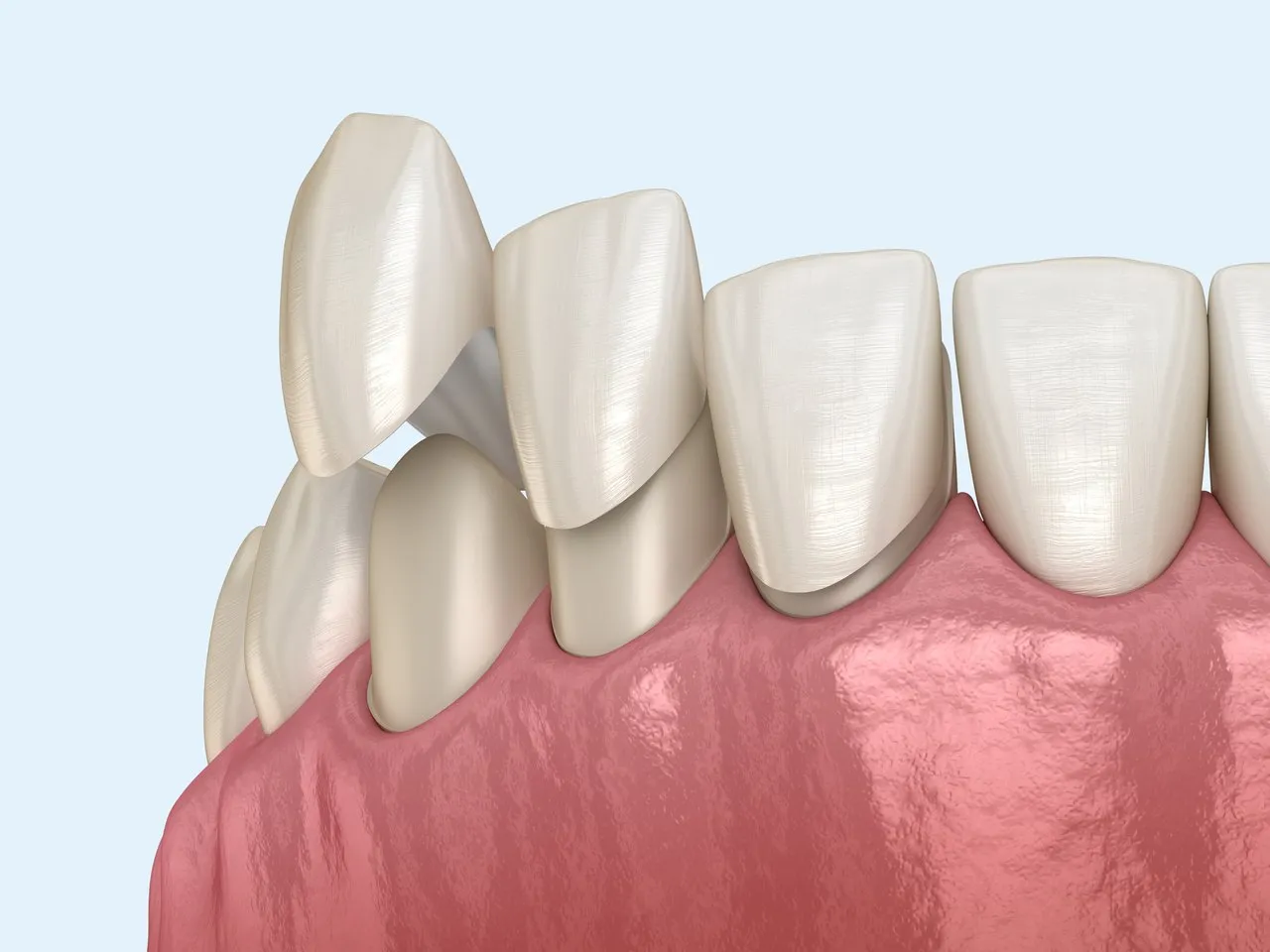
Both options change the appearance of the front teeth, but they differ fundamentally. Bonding is created directly in the mouth, usually in one appointment, without an impression or laboratory work. A ceramic veneer is made in a dental laboratory and then bonded in place. This is clearly reflected in the billing. For a veneer, the fee schedule provides item number 2220 with 2,067 points, which at the 2.3 multiplier amounts to €267.38 in dental fees alone, plus laboratory costs under § 9(1) GOZ. Alongside item numbers 2200 to 2220, filling item numbers 2050 to 2130 cannot be charged for the same tooth – a tooth therefore receives either one or the other. Clinically, the S3 guideline classifies the two as follows: whenever possible, direct procedures that preserve hard tooth tissue should be preferred; ceramic veneers can be used as an alternative. The guideline is explicitly cautious about durability. In the only study found that compared the two directly, ceramic veneers showed a higher survival rate. However, this study dates from 1998, has a follow-up period of 2.5 years and is assessed by the guideline as having a serious risk of bias. It does not support a reliable conclusion that one method is superior to the other.
What durability depends on
Composite can be repaired
This is the most important difference from ceramic. In the Frese 2013 and Wolff 2010 cohorts, overall survival after five years was 84.6 per cent, but functional survival was 100 per cent. All the build-ups could be repaired and remained in the mouth.
The difference between two percentages
Overall survival counts the time of the first failure, while functional survival continues to include repaired restorations. In the Frese 2020 multicentre study of 667 restorations, functional survival after 15 years was 98.5 per cent. Quoting only one of the two figures distorts the picture.
The material affects the appearance
The guideline reports that microfilled composites produced a better aesthetic result than universal composites, and that one study found more discolouration with nanofilled composite. One study observed fractures more frequently with microhybrid composites.
The initial situation matters
For severely worn front teeth, Poyser and Al-Khayatt found survival rates of 85 per cent over up to seven years. The Coelho-de-Souza 2015 and Lempel 2017 studies, with mean follow-up periods of 3.5 and 7.5 years, reported rates of 80.1 and 88.3 per cent respectively.
The practitioner's skill is a factor
The guideline states this itself: practitioners must have a high degree of technical skill to produce direct tooth-shape corrections. Unlike a laboratory-made veneer, the final shape is created freehand on the patient.
Prior grinding does not improve retention
Al-Khayatt and colleagues were able to show that prior preparation of the teeth did not significantly affect retention. This supports the minimally invasive or non-invasive approach recommended by the guideline.
What we do not promise
In most cases, dental bonding is an elective procedure – you choose it because you want to change something, not because it is medically necessary. The S3 guideline therefore states that, from an ethical perspective, the aim should be a minimally invasive approach that takes account of patient preference, together with a strictly prevention-oriented approach. We tell you beforehand what can and cannot be achieved with composite. We cannot guarantee a particular result because tooth colour, tooth position and the shape of the lips differ from person to person. We do not use before-and-after pictures of other patients as proof of effectiveness – such presentations are problematic under the law on advertising therapeutic products for aesthetic treatments and say nothing about your result in any case. And we advise against treatment if something else needs to be addressed first: untreated tooth decay, gum inflammation, severe teeth grinding or misalignment that would be better treated orthodontically. A build-up on an unresolved problem will neither last longer nor look better.
Frequently asked questions about dental bonding
Dental bonding is direct tooth-shape correction with composite. Tooth-coloured resin material is applied to the tooth in several layers, shaped in the mouth and light-cured. It can close gaps, widen teeth, rebuild chipped corners or match the colour of individual teeth. The S3 guideline 083-028 of January 2024 groups these applications under tooth-shape corrections in the front teeth. No impression or dental laboratory is involved.
Cosmetic shape correction is a private treatment and is billed under the German Scale of Fees for Dentists (GOZ). For a composite restoration using adhesive technique, the fee schedule lists item numbers 2060 to 2120, depending on the number of surfaces treated. At the 2.3 multiplier, which under § 5(2) GOZ represents an average service, this amounts to €68.17 per tooth for one surface, €71.92 for two surfaces, €83.05 for three surfaces and €99.60 for more than three surfaces. Which items apply in your case and what additional charges there may be depend on the findings and are set out in your treatment and cost plan, which you receive before treatment begins.
The research does not support quoting a single number of years. In the 2020 multicentre study by Frese and colleagues, involving 667 restorations in 198 patients, functional survival after 15 years was 98.5 per cent. Repaired build-ups were included because they remained in the mouth. Counting only up to the first failure, overall survival in comparable cohorts after five years was 84.6 per cent. The fact that composite can be repaired is the key difference from ceramic.
Not for purely cosmetic correction. Under § 27(1), sentence 1 SGB V, there is only an entitlement to medical treatment where it is necessary to diagnose or cure a disease, prevent it from worsening or alleviate its symptoms – shape correction without a clinical finding does not meet this requirement. If there is a genuine defect, however, such as tooth decay or a chipped corner, people with statutory insurance are entitled to a filling as a benefit in kind. If you also choose more complex treatment, the insurer covers the least expensive comparable resin filling under § 28(2) SGB V and you pay the difference; a written agreement on this must be made before treatment.
The S3 guideline recommends that, whenever possible, direct procedures that preserve hard tooth tissue should be preferred for tooth-shape correction in the front teeth; indirect ceramic veneers can be used as an alternative. Only one study has compared the two directly for durability. It showed an advantage for ceramic, but dates from 1998, includes only 2.5 years of follow-up and is assessed by the guideline as having a serious risk of bias. The reliable differences between the two options mainly concern the effort involved and loss of tooth substance: bonding is created directly in the mouth, while a veneer is made in a laboratory.
The S3 guideline describes the direct approach as minimally invasive or non-invasive and recommends preferring it whenever possible. In a randomised study, Al-Khayatt and colleagues were able to show that prior preparation of the teeth did not significantly affect retention. Grinding is therefore not necessary for retention. Whether the tooth surface needs to be altered at all in your case depends on the findings and will be discussed before treatment.
Only the adhesive technique. In orthodontic bonding, brackets, aligner attachments or retainers are fixed to the tooth enamel – the aim is tooth movement. With dental bonding in the aesthetic sense, composite material is built up to change the shape, width or colour of a visible tooth. The procedure, duration, billing and aim are completely different; only conditioning the enamel and light-curing are comparable.
Book a dental bonding consultation
We examine your teeth and gums and discuss what can be achieved with composite. We record the planned services in a written treatment and cost plan before treatment begins.