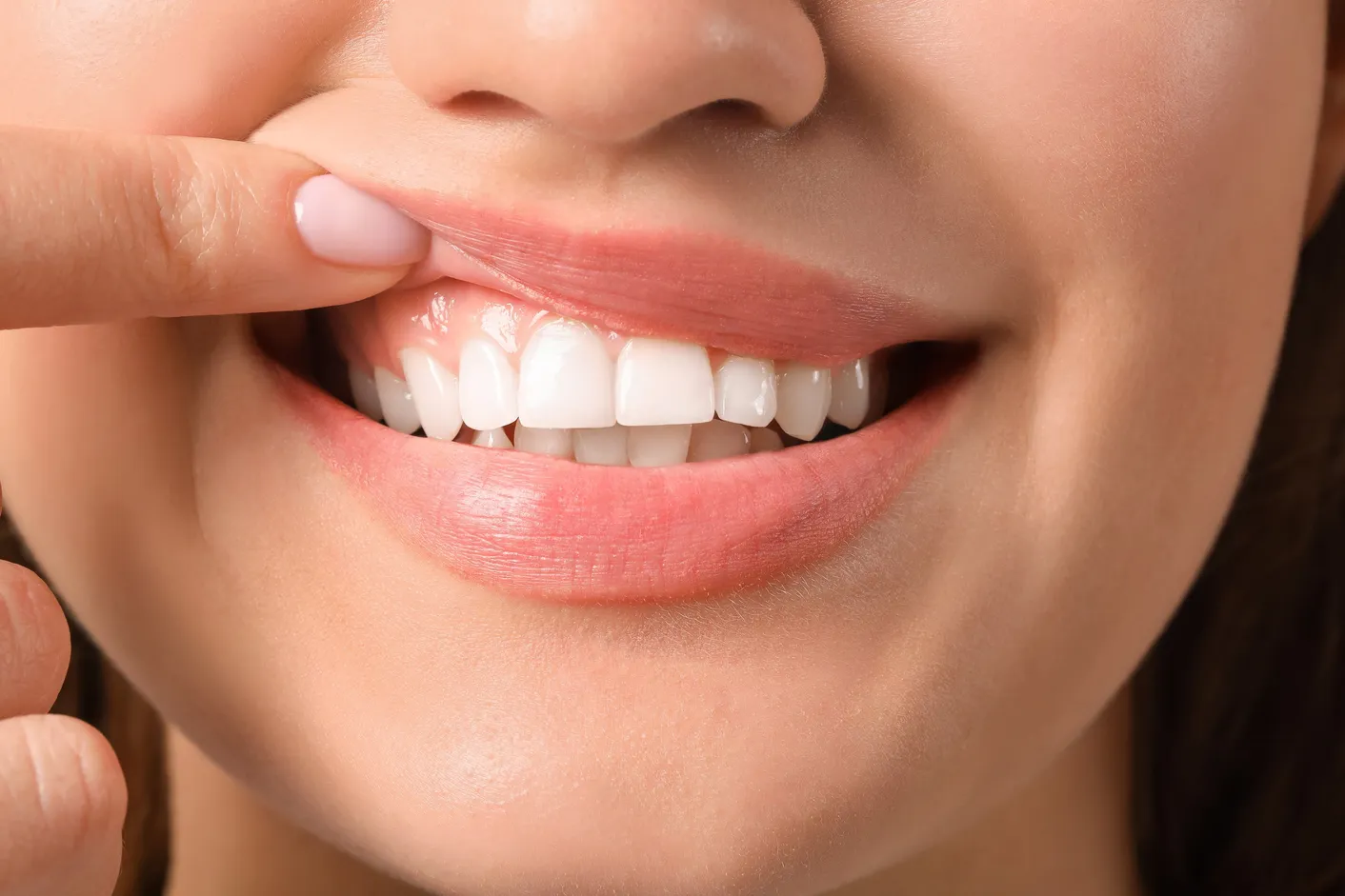
Healthy gums – how to recognise and measure them
You cannot reliably tell whether your gums are healthy by looking in the mirror. In 2018, the professional societies redefined the health of the periodontium using two measurements rather than appearance: the proportion of sites that bleed when a thin probe is carefully inserted into the gum margin, and the depth to which it slides. If bleeding occurs at less than ten per cent of the measurement sites and the probing depth is less than three and a half millimetres, the gums are considered clinically healthy. In Germany, periodontitis treatment covered by statutory health insurance may be considered from four millimetres, provided that one of the diagnoses specified in the guideline is also present.
This page explains what lies behind these two figures, why colour and firmness are not sufficient criteria on their own, how the benchmark changes after periodontitis, and what you can look out for yourself before an appointment. Our page on strengthening teeth and gums explains what benefits them in everyday life. Here, we address the question that comes first: how do we define ‘healthy’ in the first place?
Über 350 Google-Bewertungen
The values by which healthy gums are measured
The following points come from two sets of rules: the case definition of the 2018 classification, quoted verbatim in the European Federation of Periodontology’s S3 guideline, and the Federal Joint Committee’s PAR guideline, which has governed when statutory health insurance covers periodontitis treatment since 1 July 2021. Both measure the same thing, but with slightly different thresholds. One important point first: these values are measured by a dentist using a probe, not by you at home with a toothbrush.
Bleeding at less than ten per cent of measurement sites
The key criterion. The EFP S3 guideline defines clinical periodontal health as the absence of inflammation, measured as bleeding on probing at less than ten per cent of sites. At ten per cent or more, the diagnosis is gingivitis.
Probing depth below three and a half millimetres
The Periodontal Screening Index uses a WHO probe whose black band lies between 3.5 and 5.5 millimetres. If the band remains fully visible, the pocket is shallower than 3.5 millimetres. Only together with an absence of bleeding does this produce code 0, the only code that means ‘healthy’.
No loss of periodontal attachment or bone
The case definition additionally requires the absence of attachment and bone loss from previous periodontitis. People who have had periodontitis are therefore assessed against a separate benchmark.
Four millimetres as the threshold for requiring treatment
Section 4 of the PAR guideline makes entitlement to systematic treatment dependent on two conditions at once: one of the diagnoses listed there and a probing depth of 4 millimetres or more.
Six millimetres as the threshold for open treatment
If depths of 6 millimetres or more are still measured at the follow-up assessment, surgery may be indicated under § 12 of the PAR guideline. According to the guideline, there must be a strict indication for this in the front-tooth region for aesthetic reasons.
At least two measurement sites per tooth
The PAR guideline requires probing depths and bleeding on probing to be recorded at at least two sites per tooth, one towards the middle and one towards the side. Intermediate values of 0.5 millimetres and above are rounded up. This ensures that a single deep point is not overlooked.
Bleeding on probing: the one sign on which everything depends
Bleeding on probing, known in professional jargon as BOP, is the value at the heart of the case definition. It does not mean bleeding when brushing, but a standardised measurement: the probe is inserted into the gum margin at specified sites using light pressure, and the number of these sites that bleed within a few seconds is then counted. This produces a percentage.
The European Federation of Periodontology’s S3 guideline sets the thresholds as follows: less than ten per cent of sites bleeding means clinical health; from ten per cent, gingivitis; between ten and thirty per cent, localised; and above thirty per cent, generalised. This grading is based on the work of Trombelli and colleagues from 2018. Their achievement was a case definition for the person as a whole: older classifications described when an individual site was inflamed, but not the point at which someone was considered to have the disease.
This has two implications for everyday life. Bleeding is not an incidental finding but the decisive criterion, even when there is no pain. Conversely, bleeding when brushing is not proof of disease, because brushing too hard or an injured area can produce the same observation. The possible causes of recurring bleeding gums are covered on a separate page.
Probing depth: why 3.5, 4 and 6 millimetres are the decisive figures
There is a narrow groove between the tooth and the gum. A dentist measures its depth with a probe; this value is called the probing depth. Three figures structure the result, and they come from two sets of rules.
The first is 3.5 millimetres. The Periodontal Screening Index, or PSI for short, is measured with a WHO probe whose black band lies between 3.5 and 5.5 millimetres. If the band remains fully visible and there is no bleeding, the finding is code 0, the only one of the five codes that the German Society of Periodontology describes as ‘healthy’ and ‘no treatment necessary’. If the band remains visible but there is bleeding, it is code 1 and therefore already gingivitis: the depth is identical, and bleeding alone makes the difference. Code 2 represents the same depth with tartar or defective filling and crown margins, code 3 represents 3.5 to 5.5 millimetres, and code 4 represents more than 5.5 millimetres.
The second figure is 4 millimetres: § 4 of the PAR guideline makes treatment covered by statutory health insurance dependent on an appropriate diagnosis being present and a probing depth of 4 millimetres or more being measured. These are precisely the pockets cleaned during the first stage of treatment; under § 9, this non-surgical procedure should be completed within four weeks where possible.
The third figure is 6 millimetres: if depths of 6 millimetres or more are still measured at the follow-up assessment three to six months later, an additional open, that is surgical, procedure may be indicated under § 12. Our page on periodontitis treatment describes the process, while the page on periodontal diseases explains the classification into stages and grades.
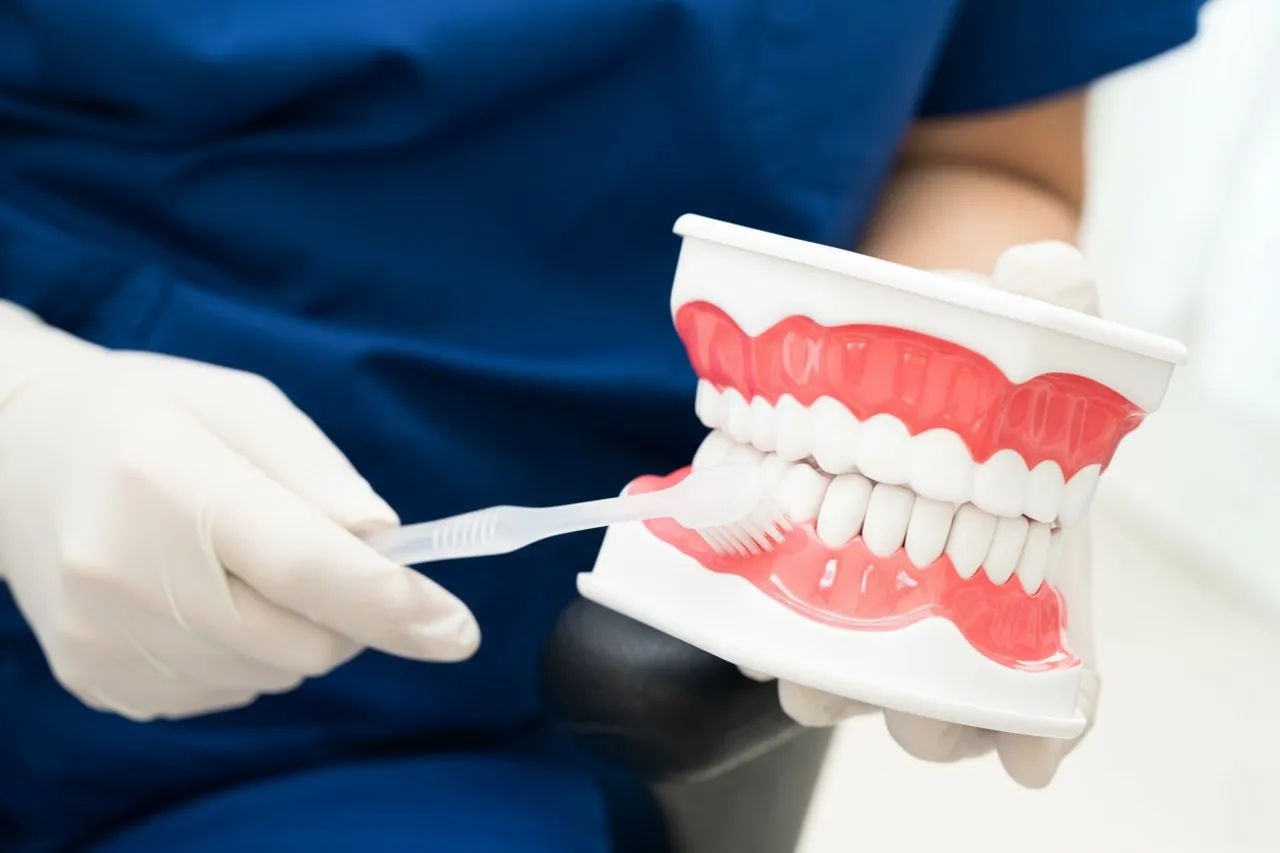
Why ‘pale pink and firm’ is not a clinical finding
Almost every advice page describes healthy gums using the same four words: pale pink, firm, tightly fitting and not bleeding. This is not wrong as an everyday description, but it is not adequate as a criterion, and the 2018 classification does not use it for three reasons.
Firstly, colour varies between individuals: the classification lists gingival pigmentation as one of eight separate categories of non-plaque-induced changes to the gums, so a difference in colour does not automatically indicate inflammation. Secondly, the European Federation of Periodontology describes inflamed gums as swollen and reddish with an onset of bleeding tendency, features that can only be recognised reliably if the same mouth has previously been seen in a healthy state. Someone whose gums have looked this way for years has no basis for comparison. Thirdly, periodontitis remains painless for a long time; the Sixth German Oral Health Study therefore calls it a silent widespread disease and describes the process as going unnoticed for years or even decades.
This is precisely why the profession has shifted the definition from description to measurement. This does not mean that appearance and sensation are unimportant: marked redness, swelling or visible recession are reasons to make an appointment. They do not replace measurement; they are the reason for it. If your gums are permanently dark red, there are various possible causes, which we have disentangled on a separate page.
There is not one state of health, but four levels
The specialist literature gives a more nuanced answer than yes or no to the question of whether gums are healthy again after periodontitis treatment. In 2018, as part of the World Workshop, Niklaus Lang and Mark Bartold proposed four levels of periodontal health.
They call the first pristine health: a structurally intact and inflammation-free periodontium. The second is well-maintained clinical health in an intact periodontium, a dentition with no previous loss of tissue whose measurements are within the healthy range. The third is called disease stability and describes a reduced periodontium in which inflammation has come to a standstill. The fourth is remission or control: also reduced, with inflammation significantly decreased but not completely resolved.
For those affected, the difference between the second and third levels matters most. Anyone who has had periodontitis cannot return to the second, because lost bone does not grow back through cleaning. The third is achievable and is a fully valid treatment goal. The next section explains which figures apply.
Healthy gums after periodontitis treatment
A separate benchmark applies to people with a reduced periodontium, and the European Federation of Periodontology’s S3 guideline describes it precisely. Patients are considered stably treated if, after completing therapy, they bleed on probing at less than ten per cent of sites, their probing depths are no more than four millimetres, and no four-millimetre site also bleeds. If these depths are achieved but bleeding is above ten per cent, the guideline refers to a stable periodontitis patient with gingival inflammation. Sites where four millimetres or more continue to be measured and which bleed on probing are considered unstable and require further treatment. The same guideline states the treatment goal as no bleeding pocket deeper than four millimetres and no pocket of six millimetres or more.
This also makes clear why aftercare is part of the treatment plan and not an optional extra. The PAR guideline provides for supportive periodontal therapy over two years for this purpose. How often treatment takes place during this period depends on the grade identified: up to twice for grade A with a slow rate of progression, up to four times for grade B, and up to six times for grade C with a rapid rate. An extension is possible, but must be approved in advance by the health insurer and generally must not exceed six months. Independently of this, the European guideline recommends aftercare appointments at intervals of three to no more than twelve months, tailored to the individual risk profile. Our page on periodontitis treatment describes the treatment process itself.
How common healthy gums really are in Germany
The Sixth German Oral Health Study, published by the Institute of German Dentists on behalf of the German Dental Association and the National Association of Statutory Health Insurance Dentists, is the first population-wide study in Germany to apply the 2018 classification; a total of 3,377 people in 90 municipalities were examined in 2023. According to the study, 3.8 per cent of the 35-to-44 age group had periodontally healthy conditions, compared with 0.0 per cent of the 65-to-74 age group.
These figures need context, otherwise they are misleading. Firstly, the benchmark is strict: in addition to minimal bleeding, it requires the absence of any previous loss of periodontal attachment or bone, which a dentition almost inevitably accumulates over decades. Secondly, the vast majority of findings are in the mild stages: among younger adults, 31.6 per cent were at stage I and 46.0 per cent at stage II, totalling 77.6 per cent, compared with 17.5 per cent at the severe stages III and IV. Thirdly, the treatment threshold differs from the scientific one: because the PAR guideline additionally requires a probing depth of at least four millimetres, 73 per cent of the same age group had an indication for treatment covered by statutory health insurance.
The conclusion is sobering: a perfect finding is rare, a mild finding is the norm, and early measurement makes the greatest difference precisely in mild cases.
Six observations that suggest you should make an appointment
Only a dental examination can establish the values discussed in the previous sections; there is no way to measure them yourself with a toothbrush. What you can observe at home are indications, not clinical findings. The following six come from the description of disease progression in § 2 and the treatment goals in § 9 of the PAR guideline, and from the European Federation of Periodontology’s patient information. We deliberately do not specify a points threshold at which an appointment becomes necessary: there is no reliable source for one, and under the 2018 case definition, regular bleeding is in any case no longer a state of periodontal health. Independently of this, people with statutory health insurance are entitled to a Periodontal Screening Index every two years as part of preventive care, the simplest way to turn suspicion into measurement.
There is regular bleeding when brushing or between the teeth
A one-off bleed after brushing too hard is different from recurring bleeding at the same sites. The latter is the most common first indication and the reason to have the value measured professionally.
The gums are swollen or markedly reddened
The European Federation of Periodontology describes inflamed gums as swollen and reddish with an onset of bleeding. What matters is the change from your normal state, not an absolute shade of colour.
Teeth appear longer, or the necks of the teeth are exposed
Section 2 of the PAR guideline describes the breakdown of periodontal attachment and bone as a consequence of the inflammatory response. This often first becomes visible as recession of the gum margin, to which we have dedicated a separate page.
A tooth feels loose or has changed position
The PAR guideline explicitly names tooth loosening and changes in tooth position, through to tooth loss, as consequences of progressive breakdown. Both should be examined promptly, even if there is no pain.
Pus is discharged, or an area suddenly becomes very painful
Alongside bleeding, § 9 of the PAR guideline explicitly names suppuration, meaning the discharge of pus, as a sign of inflammation on probing. Unlike the other points on this list, this is not a reason to wait for the next available routine appointment, but to seek one at short notice.
You smoke or have diabetes
Section 3 of the PAR guideline lists both as risk factors to be asked about, including the HbA1c value and number of cigarettes. They act as modifiers in grading the rate of progression: the German Society of Periodontology’s overview assigns non-smokers to grade A, fewer than ten cigarettes a day to grade B, and ten or more to grade C; for diabetes, the threshold is an HbA1c value of 7.0 per cent.
What is proven to influence the findings and what remains uncertain
Detailed preventive behaviour belongs on our oral hygiene page; here we cover only what is necessary to address the clinical findings. The European Federation of Periodontology’s S3 guideline provides recommendations of varying strength for people receiving periodontal aftercare.
Firstly: where anatomically possible, toothbrushing should be supplemented with interdental brushes, a recommendation of the highest grade, adopted unanimously by the guideline group. Secondly: stopping smoking and good diabetes control also carry the highest recommendation grade, and both factors reappear in grading the rate of progression. Thirdly, the guideline’s most candid statement: on dietary advice, it explicitly states that it is not known whether this has a positive influence on periodontitis therapy, with recommendation grade 0 and the addition that further research is needed, based on an evaluation of three randomised studies and four prospective investigations.
This is why there is no longer a diet plan on this page. What can be substantiated about nutrients is covered on the page about strengthening teeth and gums.
What is measured at the practice and what it costs
There are two examinations of different scope for assessing periodontal health. The smaller is the Periodontal Screening Index: the dentition is divided into six sections; in adults, all teeth except the wisdom teeth are probed, and only the highest value for each section is recorded, giving six figures between 0 and 4. Under the billing provision for BEMA number 04, people with statutory health insurance are entitled to this once every two years with no co-payment; during ongoing systematic periodontitis treatment, the service cannot be billed separately because more precise measurements are taken in any case. Privately, the assessment is billed under GOZ item 4005 with 80 points.
The more extensive examination is the full periodontal assessment. Under § 3 of the PAR guideline, it records probing depths and bleeding on probing at at least two sites per tooth, as well as tooth loosening, involvement of the root furcations, radiographic bone loss in relation to age, and tooth loss due to periodontitis; privately, it is billed under GOZ item 4000 with 160 points. Both items can be billed no more than twice a year. This is distinct from professional dental cleaning: a cleaning service rather than a diagnostic one, billed per tooth under GOZ item 1040.
The cost of a private service is determined by the number of points, the point value and the multiplication factor. Under § 5(1), sentence 3 of the GOZ, the point value is 5.62421 cents; the fee range extends from the single to the 3.5-fold fee rate. For item 4005, this means €4.50 to €15.75, and for item 4000, €9.00 to €31.50. Under § 5(2), sentence 4 of the GOZ, the 2.3-fold rate represents the average case in terms of difficulty and time required, corresponding to €10.35 and €20.70 respectively. We bill according to the work involved within this range. Where the work involved is very extensive, a rate above 3.5-fold may also be considered; under § 2(1) and (2) of the GOZ, this is only permitted with a written agreement before treatment, which must not be made a condition of emergency treatment or treatment for acute pain. Which items apply in your case depends on the findings; the amounts stated are solely the dental fee for each individual service and do not replace a cost estimate.
Frequently asked questions about healthy gums
Pale pink, firm, tightly fitting and without bleeding: this is correct as everyday guidance, but it is not sufficient as a criterion. The 2018 classification defines health using two measurements: bleeding on probing at less than ten per cent of sites and the absence of attachment and bone loss from previous periodontitis. The reason is practical: gum colour varies between individuals, the classification lists gingival pigmentation as a separate category, and periodontitis remains painless for years. What you see is a reason for an examination, not a substitute for one.
For the Periodontal Screening Index, a probing depth below 3.5 millimetres is considered unremarkable: the black band of the WHO probe, which lies between 3.5 and 5.5 millimetres, then remains fully visible. Without bleeding, this produces code 0, the only code that the German Society of Periodontology describes as ‘healthy’. From 4 millimetres, it becomes relevant to treatment: § 4 of the PAR guideline makes entitlement to systematic periodontitis treatment dependent on an appropriate diagnosis in conjunction with a probing depth of 4 millimetres or more. From 6 millimetres, an additional surgical procedure may be considered after the first stage of treatment.
A standardised measurement, not bleeding when brushing. A thin probe is inserted into the gum margin at specified sites using light pressure, after which the number of these sites that bleed is counted and converted into a percentage. The European Federation of Periodontology’s S3 guideline sets the threshold at ten per cent: below this is clinical health; from ten per cent is gingivitis; above thirty per cent is generalised gingivitis; and ten to thirty per cent is considered localised. The PAR guideline requires at least two measurement sites per tooth.
Yes, according to a separate benchmark. Lost bone does not grow back, so the specialist literature refers to disease stability in a reduced periodontium. Under the European S3 guideline, patients are considered stably treated if they bleed at less than ten per cent of sites, have probing depths of no more than four millimetres, and have no four-millimetre site that also bleeds. To maintain this, the PAR guideline provides for supportive periodontal therapy over two years, with up to two appointments for grade A, up to four for grade B and up to six for grade C.
Under the billing provision for BEMA number 04, people with statutory health insurance are entitled to a Periodontal Screening Index every two years. Anyone who has undergone periodontitis treatment will in any case have more frequent check-ups during the two-year aftercare period; the European S3 guideline recommends intervals of three to no more than twelve months for this, tailored to individual risk. In between, recurring bleeding is a reason not to wait until the next routine appointment.
According to the Sixth German Oral Health Study, the first population-wide study in Germany to use the 2018 classification, the figure is 3.8 per cent in the 35-to-44 age group and 0.0 per cent in the 65-to-74 age group. The benchmark is strict because it additionally requires the absence of any previous bone or periodontal attachment loss. The vast majority of findings are in the mild stages: among younger adults, stages I and II together account for 77.6 per cent. In this age group, 73 per cent had an indication for treatment covered by statutory health insurance.
Book your appointment now
We would be happy to advise you in person at our practice.