Removing dental plaque: which home remedies work – and which cost you enamel
Baking powder, activated charcoal, salt, lemon, coconut oil: anyone looking into dental plaque soon comes across home remedies, and the recommendations contradict one another. This page goes through them individually and explains what each one promises, what actually happens and what it is good for. The starting point is a surprising figure: one brushing session removes an average of 42 per cent of plaque, and toothpaste has been shown to contribute very little to this. It is the brush that does the cleaning. This inherently limits what a home remedy used instead of toothpaste can achieve — but not the harm it can do. Incidentally, two of the eight remedies discussed really are useful, just not for brushing. If you want to know what dental plaque actually is, how it forms and the damage it can do in the long term, read our detailed page about dental plaque; here, we look at what you can do about it at home.
Über 350 Google-Bewertungen
What exactly is dental plaque?
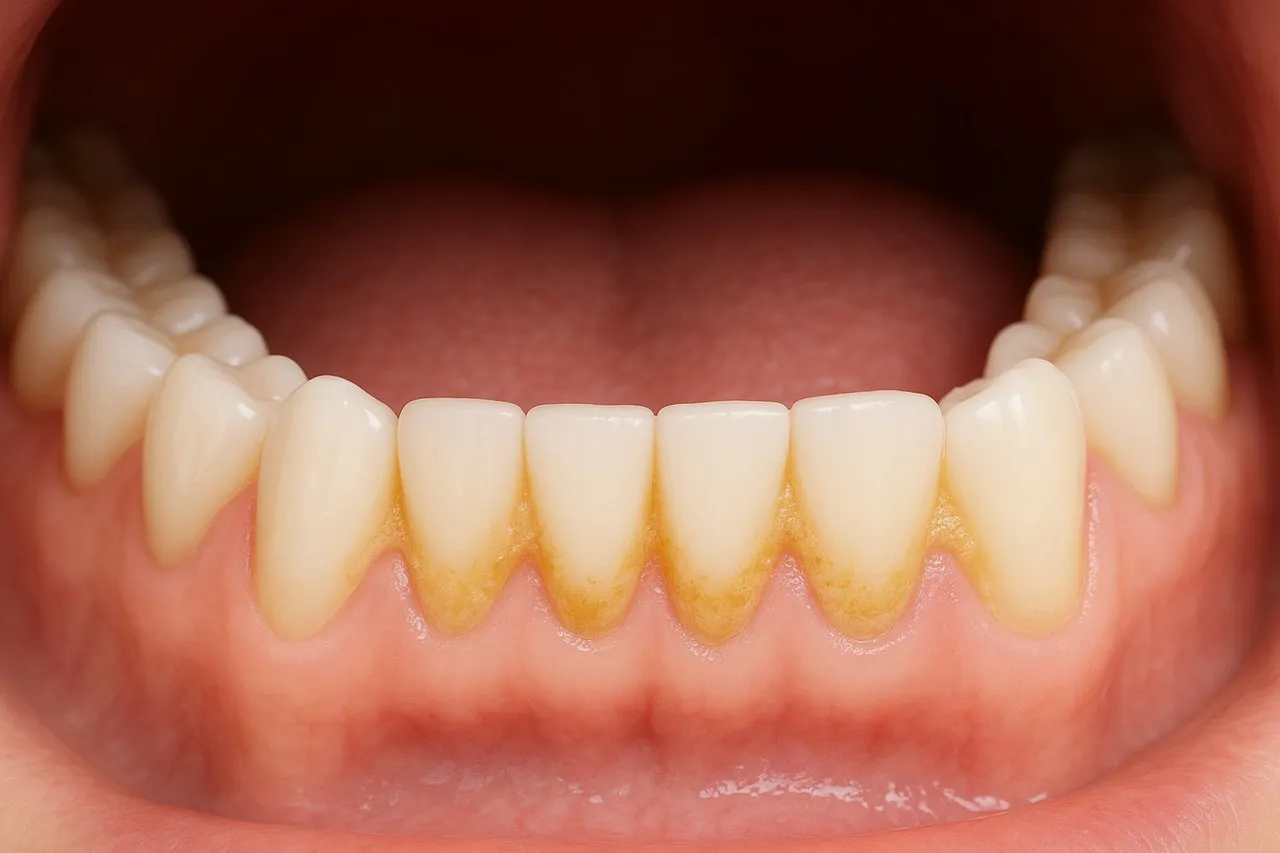
Dental plaque is a soft biofilm on the surfaces of the teeth. It consists of bacteria, components of saliva and food debris. Over time, it can turn into hard deposits such as tartar. Plaque adheres particularly well in hard-to-reach places. These include the spaces between the teeth and the area where the teeth meet the gum line. It often remains unnoticed there for a long time.
Dental plaque, plaque, tartar: three words, two things
Dental plaque and plaque are the same thing. It is the soft, sticky film made up of bacteria, components of saliva and food debris that forms anew on the teeth every day, and you can remove it mechanically yourself. Tartar is something different: calcified plaque that has incorporated minerals from saliva over days and weeks and is therefore firmly attached to the tooth surface. It cannot be removed by brushing, nor can any home remedy remove it — that requires instruments at the dental practice. This one distinction determines everything that follows on this page. As long as plaque is soft, it is your responsibility. As soon as it is hard, it is ours. Anyone using a home remedy to tackle tartar is fighting something that the remedy simply cannot overcome, and risks damaging the surface beneath it. You can find out what tartar is, how quickly it forms and what happens when it is removed on our tartar page; you can read why you should not scrape it off yourself under removing tartar yourself.
Why plaque is a biofilm – and what that means for home remedies
Dental plaque is not loose dirt, but a biofilm: an organised community of bacteria that embeds itself in a self-produced layer and uses it to adhere to the tooth surface. This is precisely why rinsing is not enough. A liquid reaches the outer layer and runs off; the bacteria beneath it are protected. A biofilm is broken up mechanically — by bristles moving across the surface. Current guidelines state this unequivocally: the basis of prevention is careful mechanical oral hygiene, supplemented by some form of interdental cleaning. Antibacterial mouthwashes can improve this outcome; they cannot replace it. This is the benchmark against which every home remedy must be measured: can it mechanically disrupt a biofilm? Oil pulling and rinses cannot; they are chemical. Powders and pastes can only do so insofar as the brush is doing the work anyway. And one figure makes this even clearer: with or without toothpaste, brushing only removes around half of the biofilm — the presence of toothpaste has a secondary influence on cleaning performance. Toothpaste is not a cleaning agent; it is a fluoride carrier.
The one sentence that puts all home remedies into perspective
Before looking at individual remedies, it is worth considering what they are actually meant to replace. A systematic review of ten randomised studies with twenty comparisons investigated whether toothpaste helps at all to remove plaque when brushing. The result: its influence on plaque removal is secondary. It is the brush that does the cleaning. Two conclusions follow, and both are inconvenient for the usual home-remedy guides. Firstly: anyone who uses bicarbonate of soda, charcoal or salt instead of toothpaste is replacing the very ingredient that contributes least to cleaning — so the promised improvement in cleaning simply cannot be significant. Secondly: what toothpaste really achieves is lost in the process. Fluoride hardens the tooth surface and is the best-evidenced measure against caries of all; the current S3 guideline on caries prevention requires at least 1,000 ppm fluoride in toothpaste, with the highest recommendation grade and adopted unanimously. No home-remedy powder contains fluoride. The harm therefore rarely lies where the guides suspect it does, namely in the remedy itself destroying the enamel — it lies in omission. If you still want to know which remedy does what, you will find this in the next section, remedy by remedy.
Eight home remedies assessed individually
The following eight remedies are the ones people actually search for. For each, we explain what it promises, what happens and what it is good for. Where there is reliable research evidence, we mention it; where there is none, we say that too. Two of the eight perform well — and they are not the ones used for brushing.
Bicarbonate of soda
It promises gentle cleaning and whiter teeth. In fact, sodium bicarbonate is softer than enamel and dentine and is therefore considered a low-abrasion cleaning agent in dentistry — the common warning that bicarbonate of soda roughens the tooth surface is therefore not tenable. The catch lies elsewhere: bicarbonate of soda contains no fluoride, and the whitening effect comes from removing external discolouration, not from lightening the tooth itself. Verdict: probably does no harm, but is no substitute for toothpaste.
Baking powder
It is often equated with bicarbonate of soda, but they are not the same. The studies on which the classification as ‘gentle’ is based specifically concern sodium bicarbonate — in other words, bicarbonate of soda. Baking powder is a raising agent and contains other ingredients that vary from product to product and are listed on the packet. What these do in the mouth has not been studied. Verdict: intended for cakes, not teeth. Find out more on our page about brushing your teeth with baking powder.
Activated charcoal
The most heavily promoted and least well-evidenced remedy of the group. A literature review examined 118 papers and found not a single clinical study lasting at least three months that met the inclusion criteria; three studies reported adverse effects. A systematic review from 2023 summarised 11 of 208 papers, all laboratory experiments with a moderate to high risk of bias, and found less whitening effect combined with greater abrasive potential. Many products also lack fluoride. Verdict: the only remedy on this list that we advise against.
Salt
It promises cleaning through friction and a ‘disinfecting’ effect on inflamed gums. There is no clinical research on salt as a dental abrasive that would support a recommendation. As for rinsing: the guideline on chemical biofilm control did not assess salt solutions; proven additional effects are listed there for essential oils, chlorhexidine and triclosan/copolymer, and even then only as a supplement to mechanical cleaning. Verdict: unproven; see our page on brushing your teeth with salt for details.
Lemon
The remedy whose mechanism most clearly works against it. Citric acid dissolves minerals from the tooth surface — this is erosion, and it is not the same as caries. An early carious lesion can remineralise; a tooth eroded by acid cannot. The impression of whitening occurs because surface is lost. Verdict: do not use. Details in the section below.
Oil pulling with coconut or sesame oil
A systematic review from 2026 covering 31 studies found moderate reductions in bacterial counts and improved gum measurements for oil pulling, with inconsistent results compared with chlorhexidine rinses, and expressly urged cautious interpretation because of methodological weaknesses. The crucial point remains: it is a rinse. It does not break up a biofilm mechanically. Verdict: acceptable as a supplement, but not as a replacement for a toothbrush and interdental cleaning.
Disclosing tablets
The most useful item on this list, and not one for brushing. Disclosing tablets reveal where plaque has been left behind. That is exactly where their benefit lies, because in video observations 10 to 20 per cent of participants failed to reach the inner surfaces, or did so inadequately, without realising it. To be transparent: in a systematic review of seven studies involving 430 people, 11 of 13 comparisons showed no significant difference in plaque scores compared with standard oral hygiene instruction; gum measurements were better in people wearing fixed braces. Verdict: useful for checking your own cleaning, especially with fixed braces.
Tongue cleaner
The second remedy that does have an effect — against bad breath, not dental plaque. A separate biofilm sits on the back of the tongue, and reducing it can reduce bad breath with causes in the mouth. The guideline recommends tongue cleaning for diagnosed oral halitosis, but expressly does not issue a general recommendation, because the evidence for an additional benefit over the toothbrush alone is weak. Verdict: targeted use for bad breath, not as a routine measure against plaque.
The abrasion question: what dental abrasives really do
‘It roughens the enamel’ is the standard objection to home remedies, and it is almost always asserted without explaining the mechanism. The mechanism is simple: an abrasive can only wear away something softer than itself. Sodium bicarbonate — bicarbonate of soda — is softer than enamel and dentine and is therefore a comparatively gentle abrasive; the dental literature expressly classifies bicarbonate of soda toothpastes as low-abrasion. With activated charcoal, the opposite is true: most of the available laboratory experiments find increased abrasive potential together with less whitening effect than other agents. A second finding from the caries prevention guideline is also important: brushing with a toothbrush alone, that is, without toothpaste, causes no mechanical damage to either enamel or dentine when used as intended — damage results from the combination of brush and abrasive, especially where dentine is exposed. Anyone with exposed tooth necks should therefore avoid highly abrasive toothpastes; this applies just as much to a home-made powder as to a shop-bought whitening toothpaste. And one detail few people know: the guideline on biofilm management at home expressly recommends not putting toothpaste on interdental brushes — strong consensus, 43 out of 43 votes. The guideline gives no reason for this; it bases the recommendation on a case report.
Lemon and acid: erosion is different from tooth decay
Tooth decay occurs because bacteria in plaque ferment sugar and produce acid in the process, which demineralises localised areas of the tooth. Erosion occurs because acid from outside comes into direct contact with the tooth surface and dissolves it across a broad area — without bacteria, without plaque. Both involve acid, but they progress differently, and the most important difference is this: an early carious lesion can remineralise under the influence of fluoride. A tooth eroded by acid cannot. What is gone stays gone. In a laboratory study of sixty foods, drinks and medicines, pH proved to be the most influential factor in erosive potential; together with buffering capacity and calcium and fluoride content, it explained just over half of the observed loss of enamel hardness after two minutes of exposure. Lemon juice is at the acidic end of this spectrum. Applying it deliberately and repeatedly to the teeth therefore does the opposite of what advice pages promise. Incidentally, one common recommendation is now outdated: under the current state of caries prevention, waiting to brush after eating acidic foods can no longer be upheld — the guideline counters that this can easily result in cleaning being omitted altogether, which then increases the risk of tooth decay.
Disclosing tablets and tongue cleaners: the two that do something useful
Two of the remedies discussed deserve their own recommendation, and neither works in the way you might expect. Disclosing tablets clean nothing. They stain existing plaque and show in the mirror which surfaces the brush regularly misses. This is valuable because these misses are systematic: in video observations, 10 to 20 per cent of participants did not reach the inner surfaces of the teeth at all, or did so inadequately — and none of them knew it. In all honesty, the measured benefit is modest: in a systematic review of seven randomised studies involving 430 people, eleven of thirteen comparisons showed no significant difference in plaque scores compared with standard oral hygiene instruction; gum measurements were better in people with fixed braces. Disclosing tablets are therefore a good way to check your own cleaning, not a miracle cure. The tongue cleaner, meanwhile, tackles a different problem: the back of the tongue has its own biofilm, and reducing it can lessen bad breath caused by conditions in the mouth. The guideline recommends tongue cleaning for diagnosed oral halitosis using a device that does not trigger a gag reflex — but expressly makes no general recommendation because the additional benefit over a toothbrush alone is only weakly supported by evidence. A tongue cleaner does nothing about dental plaque on the teeth.
What you really can do at home
Soft plaque is your responsibility, and the proportion you can control yourself is substantial. Specifically, you can deal at home with plaque on all surfaces the brush can reach, plaque between the teeth if you use a suitable aid, plaque on the tongue, and checking whether you are really managing all of this. You cannot deal at home with calcified plaque, in other words tartar, or plaque below the gum line. Two figures put expectations into perspective: one brushing session reduces the plaque score by an average of 42 per cent, with a range across studies of 30 to 53 per cent. And between 30 and 40 per cent of all tooth surfaces are in the spaces between teeth, which a brush cannot reach because of its design. So anyone who only brushes leaves a considerable proportion untouched — not out of carelessness, but because a brush cannot reach it. This is precisely why interdental cleaning is not an optional extra for the particularly enthusiastic, but the area with the greatest untapped benefit.
Brushing technique: why a systematic approach matters more than the technique
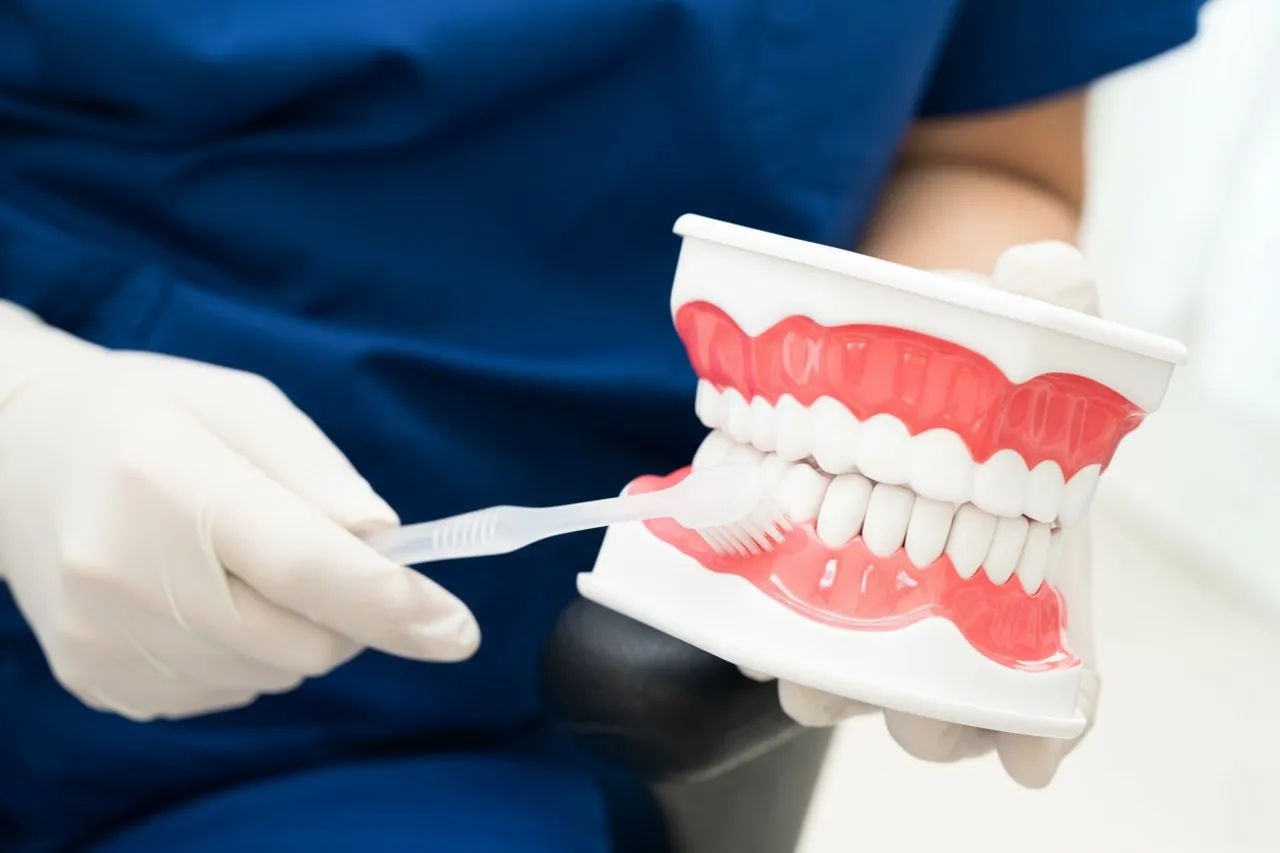
The current S3 guideline on caries prevention records a consensus that no toothbrushing technique has yet been found to be superior to another. In a randomised controlled trial, even the demonstrably correctly adopted Bass technique did not lead to better plaque removal. What matters instead is a systematic approach: a fixed sequence that ensures every surface is covered — outer, inner, chewing surfaces, every quadrant, in the same order every time. The guideline expressly recommends teaching an individually suitable systematic approach so that all tooth surfaces are reached equally. Here are three evidence-based benchmarks. Brush at least twice a day with fluoride toothpaste: highest recommendation grade, adopted unanimously. Brush for at least two minutes: one minute of brushing reduces the plaque score by 27 per cent, two minutes by 41 per cent, and extending brushing beyond two to three minutes brings no further benefit. And use toothpaste containing at least 1,000 ppm fluoride. People using an electric toothbrush gain an additional plaque reduction of around 11 per cent in studies lasting up to three months and 21 per cent in longer studies — useful, but no substitute for a systematic approach, because the same surfaces are missed even with an electric brush. Our oral hygiene page explains in detail how to put this into practice in everyday life.
The aids for which there is evidence
Unlike with home remedies, the research evidence here is robust. The following assessments come from the S3 guidelines on biofilm management at home and caries prevention. Each point includes the strength of the recommendation so that it is clear what is established and what is merely plausible.
Toothbrush, twice a day, for at least two minutes
Twice a day: highest recommendation grade, adopted unanimously (S3 guideline 083-021, recommendation 1, grade A). At least two minutes: recommendation grade B in 083-021, highest recommendation grade in 083-022 with 44 out of 44 votes. One brushing session reduces the plaque score by an average of 42 per cent.
Fluoride toothpaste containing at least 1,000 ppm
Recommendation grade A, vote 14 to 0, highest level of evidence. Notably, toothpaste contributes very little to mechanical cleaning — its value lies entirely in the fluoride.
Interdental brushes
These should be used preferentially because they have the strongest evidence and the greatest effect on gum inflammation. High recommendation grade, consensus strength 40 out of 40. The size must suit the space between the teeth.
Dental floss
An alternative when the space is too narrow for a brush — this is how the guideline expressly puts it. For caries prevention, regular interdental cleaning several times a week is considered biologically plausible, recommendation grade B, vote 14 to 0.
Electric toothbrush
Can be recommended to improve cleaning; the additional effect is around 11 per cent in studies lasting up to three months and 21 per cent thereafter. Here too, there is no benefit without a systematic approach.
Water flosser
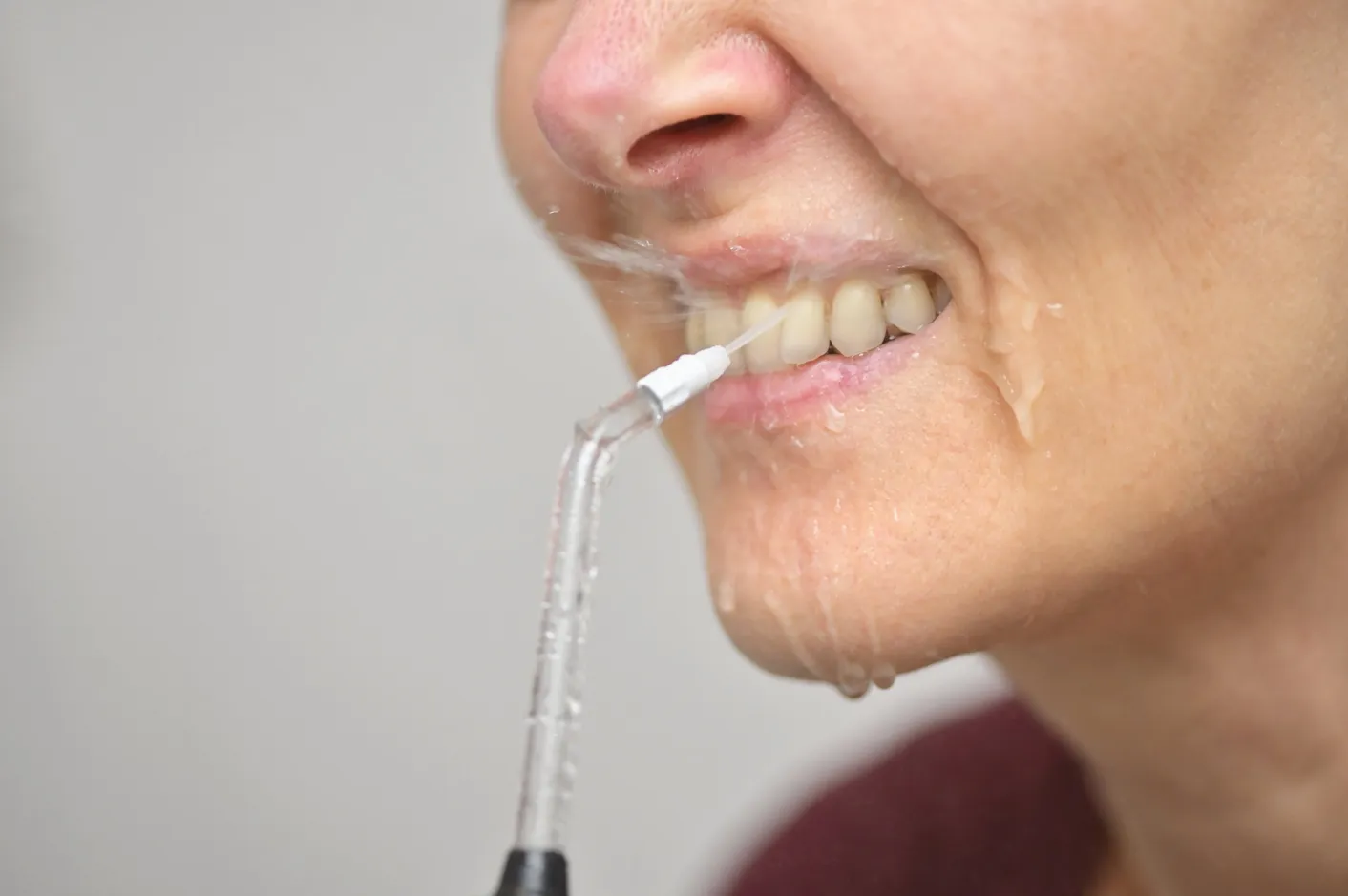
Weakly rated. The 2019 Cochrane review found low-certainty evidence that water flossers are no more effective than toothbrushing alone; the extent of biofilm reduction remains unclear. Useful at most as a supplement, not as a replacement for a toothbrush or interdental brush.
Mouthwash
Expressly a supplement only. The guideline on chemical biofilm control states first and foremost that careful mechanical oral hygiene remains the basis; proven additional effects exist for essential oils, chlorhexidine and triclosan/copolymer.
Disclosing tablets
Not a cleaning agent, but a visual check. Useful for finding your own blind spots; the measured additional benefit for plaque scores is small and is best evidenced in people with fixed braces.
Brown plaque, discolouration, smoker's plaque
The most common reason laypeople search for ‘dental plaque’ is not the biofilm, but its colour. A distinction is useful here. Soft plaque is whitish to yellowish and can be brushed away. Brown or dark edges are usually external stains — from coffee, tea, red wine or tobacco — that become embedded in the plaque layer and in irregularities on the surface. As long as they are in the plaque layer, they are removed along with it during cleaning; if they are more firmly attached, this is where professional cleaning and polishing can achieve something that cannot be done at home. Dark spots can also be something entirely different: tartar becomes discoloured over time, and a brown spot in a fissure can be tooth decay. This is why the order matters: first have it examined to establish what it is, then decide what will help. Reaching for whitening powder at this point is precisely the wrong thing to do, because it masks a finding instead of clarifying it. We have compiled separate information on what helps with existing brown discolouration.
Where self-help ends – and what professional cleaning costs
There are two things nobody can do at home: remove calcified plaque and reach plaque below the gum line. Professional dental cleaning is for calcified plaque on the tooth surfaces and at the gum line. If the plaque sits deeper beneath the gum, it no longer falls within this service but within periodontal treatment — a separate service with its own fee items. The German Dental Fee Schedule (GOZ) states verbatim what professional dental cleaning includes: ‘the removal of supragingival/gingival deposits on tooth and root surfaces, including cleaning of the interdental spaces, removal of the biofilm, surface polishing and appropriate fluoridation measures, per tooth or implant or bridge unit’. Because it is charged per tooth, the amount can be calculated: item 1040 has 28 points, the statutory point value is 5.62421 cents, and the 2.3-fold multiplier represents the average service under the fee schedule. This works out at €3.62 per tooth and €101.36 for a full set of 28 teeth. The full range under the fee schedule is €1.57 to €5.51 per tooth, or €43.96 to €154.28. In each case, this is solely the dental fee for item 1040 and not a total price. We bill according to the work involved within the framework of the fee schedule; where the work involved is exceptionally great, a rate above 3.5-fold may also be applied, which requires a written agreement before treatment under Section 2(1) and (2) of the fee schedule. For people with statutory health insurance, professional dental cleaning is a private service. Tartar removal alone must be distinguished from this: it is covered by statutory health insurance once per calendar year, or once per calendar half-year for people with a care grade or receiving integration assistance. Read our pages on professional dental cleaning and the cost of dental cleaning to find out how professional cleaning works, how often it is advisable and what additional charges may apply.
Hard deposits and tartar
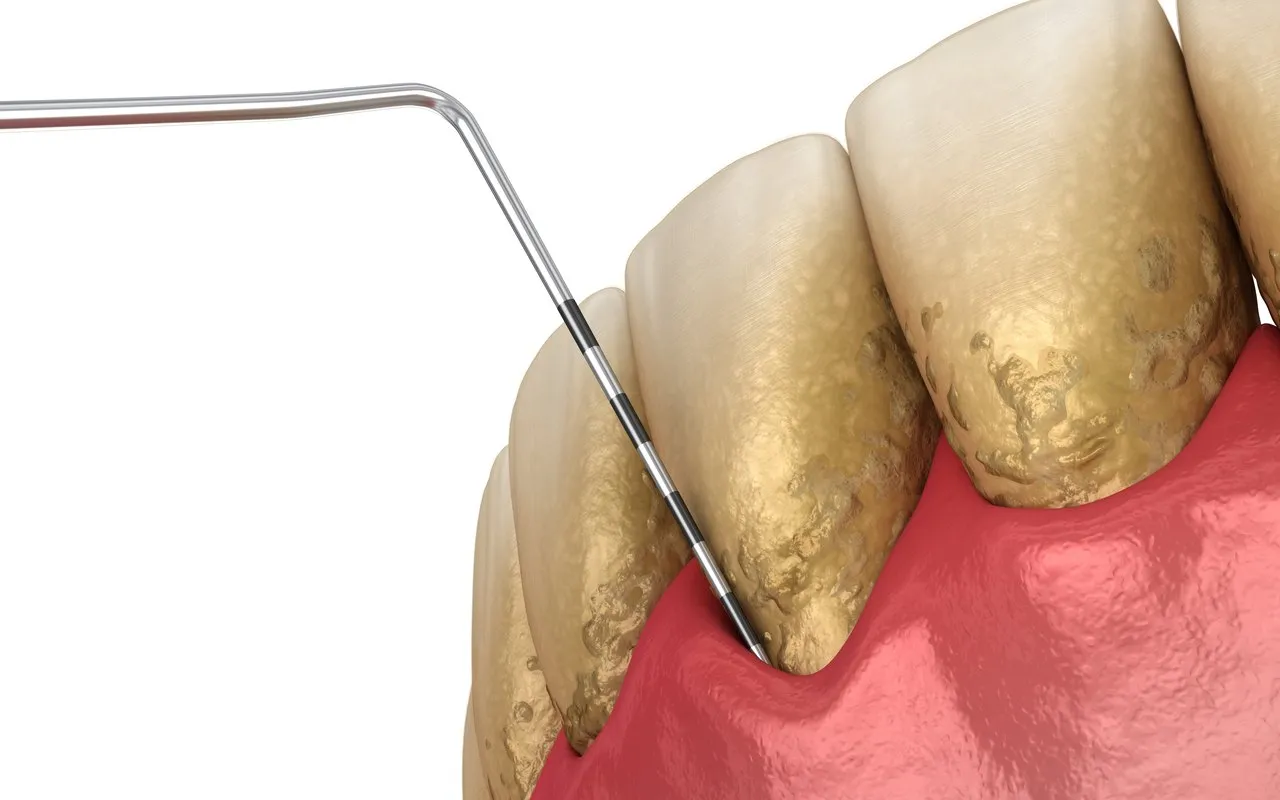
If soft plaque is not removed in time, it calcifies. This is how tartar forms on teeth and at the gum line. Tartar can no longer be removed with a toothbrush. Only dental instruments can remove it safely. This is done as part of a professional dental cleaning. Untreated tartar continuously irritates the gums. Bleeding during brushing and swelling are possible consequences. A visit to the dentist is strongly advisable in this case.
Preventing dental plaque – everyday tips
Consistent oral hygiene reduces new deposits. Regular brushing, interdental care and mouthwash are crucial. Diet also plays an important role. Sugary snacks encourage bacterial activity. A high-fibre diet and low-sugar drinks are better. Smoking increases inflammation in the mouth. It also encourages stubborn plaque and discolouration. Stopping smoking also significantly improves oral health. Regular check-ups at Wunschlachen provide additional help. This allows us to identify problems early. Together, we can keep your teeth healthy in the long term.
When you should no longer try to resolve this yourself
Four observations are a reason to make an appointment rather than continuing to experiment yourself. Firstly, your gums bleed regularly during brushing or interdental cleaning. Secondly, you can feel rough, hard areas with your tongue that do not change with brushing — this is typical of calcified plaque. Thirdly, an area of discolouration is localised rather than spread across a surface, or it is in a depression on the chewing surface. Fourthly, a tooth is sensitive to cold, sweetness or touch. None of these points is a finding in itself, and none is a reason to worry — but all four are things that need to be examined rather than covered up. Our dental plaque page explains in detail why plaque that is not removed can lead to tooth decay, gum inflammation and periodontitis in the long term.
Frequently asked questions about dental plaque and home remedies
Only to a limited extent, and for a reason almost nobody mentions: it is the brush that does the cleaning, not the toothpaste. A systematic review of ten randomised studies found that toothpaste had only a secondary influence on plaque removal. Anyone who replaces it with bicarbonate of soda, charcoal or salt is therefore swapping the ingredient that contributes least to cleaning — but losing the fluoride that the S3 guideline on caries prevention requires at a concentration of at least 1,000 ppm.
Baking powder and bicarbonate of soda are not the same. Sodium bicarbonate — bicarbonate of soda — has been shown to be softer than enamel and dentine and is therefore considered a low-abrasion dental abrasive; the common warning that it roughens enamel is therefore not tenable. Baking powder, by contrast, is a raising agent with other ingredients that vary by product and have not been studied for use in the mouth. Neither contains fluoride, and neither replaces toothpaste.
The evidence is limited and tends to be unfavourable. A literature review examined 118 papers and found no clinical study lasting at least three months that met the inclusion criteria; three studies reported adverse effects. A systematic review from 2023 summarised 11 laboratory studies and found less whitening effect combined with greater abrasive potential. There is therefore no reliable evidence of efficacy and safety.
Yes to soft plaque, no to calcified plaque. Soft plaque can be removed with a toothbrush, interdental brush or dental floss. Tartar is firmly attached to the tooth surface and can only be removed with instruments at the dental practice. One figure helps set expectations: one brushing session reduces the plaque score by an average of 42 per cent, with a range of 30 to 53 per cent — which is why regularity matters more than force.
At least twice a day with fluoride toothpaste and for at least two minutes. Both are stated in the S3 guideline on caries prevention, the first recommendation with the highest recommendation grade. In studies, one minute of brushing reduced the plaque score by 27 per cent and two minutes by 41 per cent; extending brushing beyond two to three minutes brought no further benefit.
According to current knowledge, no particular one. The S3 guideline records a consensus that no toothbrushing technique has yet been found to be superior to another; in a randomised study, even the correctly adopted Bass technique did not produce better plaque removal. What matters is a fixed systematic approach that covers all surfaces — in video observations, 10 to 20 per cent of participants failed to reach the inner surfaces, or did so inadequately.
Possibly as a supplement, but not as a replacement. A systematic review from 2026 covering 31 studies found moderate reductions in bacterial counts and better gum measurements, but expressly urged cautious interpretation because of methodological weaknesses. Above all, oil pulling is a rinse, and a rinse does not break up a biofilm mechanically. The guidelines therefore state first and foremost that mechanical cleaning remains the basis.
It is charged per tooth under the German Dental Fee Schedule (GOZ). Item 1040 has 28 points, the point value is 5.62421 cents, and the 2.3-fold rate represents the average service: this works out at €3.62 per tooth and €101.36 for 28 teeth. The full fee range is €1.57 to €5.51 per tooth, or €43.96 to €154.28. This is solely the fee for item 1040 and not a total price. We bill according to the work involved within the framework of the fee schedule; a rate above 3.5-fold requires a written agreement before treatment. For people with statutory health insurance, professional dental cleaning is a private service. We have compiled the details on our page about the cost of dental cleaning.
Yes, the removal of hard dental deposits is covered by statutory health insurance once per calendar year; once per calendar half-year for people with a care grade under Section 15 of SGB XI or receiving integration assistance under Section 99 of SGB IX. Professional dental cleaning must be distinguished from this: it includes more and is not a standard benefit under statutory health insurance.
No, and it causes damage that cannot be reversed. Citric acid dissolves minerals from the tooth surface — this is erosion. The difference from tooth decay is crucial: an early carious lesion can remineralise under the influence of fluoride; a tooth eroded by acid cannot. In a laboratory study of sixty foods and drinks, pH was the most important factor influencing erosive potential.
They do not clean; they reveal. Stained plaque shows which surfaces the brush regularly misses — and this is useful because these misses go unnoticed. The measured additional benefit is modest, however: in a review of seven studies involving 430 people, eleven of thirteen comparisons showed no significant difference in plaque scores; gum measurements were better in people with fixed braces.
Not with plaque on the teeth. The back of the tongue has its own biofilm, and reducing it can lessen bad breath caused by conditions in the mouth. The S3 guideline recommends tongue cleaning for diagnosed oral halitosis, but expressly makes no general recommendation because the evidence for an additional benefit over a toothbrush alone is weak.