Impacted tooth: findings and treatment options
An impacted tooth remains wholly or partly within the jaw instead of erupting normally into the dental arch. This can affect wisdom teeth or upper canines, for example. The term initially describes a finding. It does not automatically mean that the tooth has to be removed. An examination will establish its position, stage of development and possible effects on neighbouring structures.
The short answer
An impacted tooth has not erupted normally into the dental arch. What happens next depends on the type of tooth, its position and development, and any possible consequences.
- Impacted, displaced or simply not yet erupted?
- Not every tooth that is still missing from the mouth already requires treatment. In children and adolescents, the stage of development is important. Teeth do not erupt at the same time in everyone. An expected tooth may still be developing normally, be in an unfavourable position or fail to appear for other reasons.
- What symptoms or consequences are possible?
- An impacted tooth may be discovered without causing any noticeable symptoms. Nevertheless, it must be assessed to determine whether it is affecting neighbouring teeth or other structures. Depending on its position, inflammation or damage to adjacent roots may be a concern, for example. These risks are not the same for every finding.
- Monitor, expose or remove?
- Depending on the tooth and the findings, monitoring may be an option. It should be clear what will be checked and when the tooth will be reassessed. Monitoring is an agreed approach with a goal, not simply indefinite waiting without an explanation.
- Follow-up appointments and warning signs
- Check-ups remain important after treatment or when monitoring has been agreed. They can show whether progress matches the plan or whether further measures are needed. Ask which changes you should look out for at home and which symptoms mean you should get in touch sooner.
Impacted, displaced or simply not yet erupted?
Not every tooth that is still missing from the mouth already requires treatment. In children and adolescents, the stage of development is important. Teeth do not erupt at the same time in everyone. An expected tooth may still be developing normally, be in an unfavourable position or fail to appear for other reasons.
‘Impacted’ describes the tooth's failure to emerge. ‘Displaced’ refers to an abnormal position or direction. Both findings can occur together, but they are not identical in every situation. In addition, a tooth missing from the mouth may never have formed at all. These differences cannot be reliably determined from the outside.
With such a finding, first ask which tooth is meant and how its position was established. A precise description is more helpful than the general statement that ‘there is still a tooth in there’. It forms the basis for discussing treatment or monitoring.

Why can a tooth remain in the jaw?
A tooth may have developed in an unfavourable direction or its path may be obstructed. The amount of space available and its relationship to other teeth also play a role. With upper canines, for example, eruption may occur outside the intended dental arch or the tooth may be located in the palate.
A retained baby tooth can indicate that the permanent successor should be assessed more closely. On its own, however, it does not prove impaction and should not be extracted by yourself. A decision on removal requires the full findings and, where appropriate, orthodontic planning.
Ask for an explanation of the suspected cause in your situation and what information is still missing. The article on baby teeth describes their role in the development of the dentition. Additional information on wisdom teeth is available under wisdom teeth; this group has its own treatment considerations.
What symptoms or consequences are possible?
An impacted tooth may be discovered without causing any noticeable symptoms. Nevertheless, it must be assessed to determine whether it is affecting neighbouring teeth or other structures. Depending on its position, inflammation or damage to adjacent roots may be a concern, for example. These risks are not the same for every finding.
With partially erupted teeth, the accessible and covered areas may differ in how easily they can be cleaned. Pain or swelling should therefore not be dismissed as an inevitable part of eruption. New symptoms should be examined promptly by a dentist.
Even if you have no pain, ask about the specific reason for a recommended measure. Is damage already visible, is there a particular risk, or is the issue how the tooth fits into the dental arch? A clear reason for treatment is more helpful than a blanket recommendation to remove all unerupted teeth.
Which examinations help with planning?
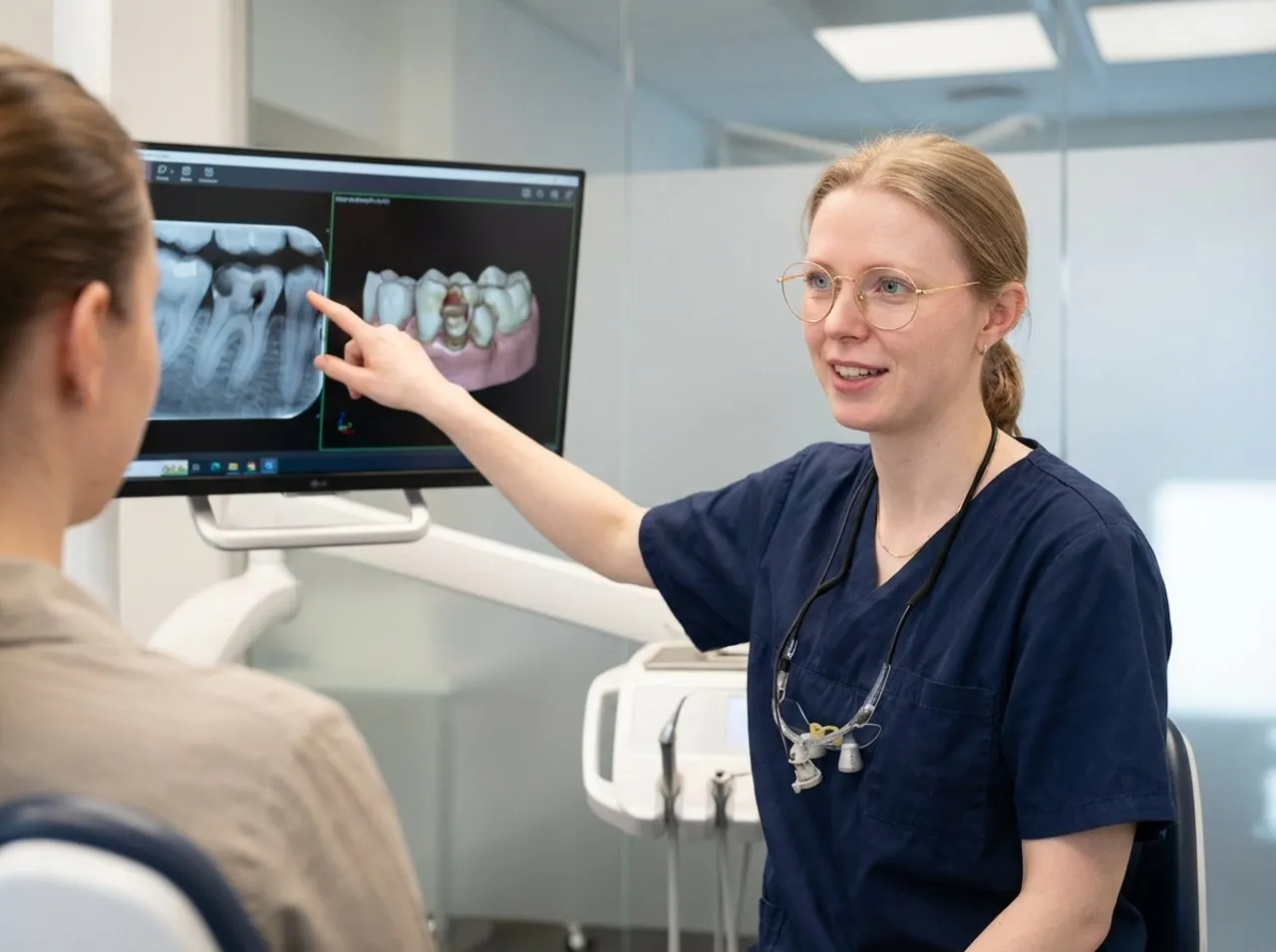
The assessment begins with your medical history and an examination of your teeth. This includes looking at the teeth present, the transition from baby to permanent teeth and the space available. Appropriate X-rays can show whether the tooth is present and how it is positioned in relation to neighbouring teeth.
Additional imaging is selected according to individual need. A three-dimensional image is not automatically required for every missing tooth. The current patient guideline on orthodontic diagnostics describes how the findings and the clinical question influence the choice of measures.
Bring any previous images and records with you if you have them. Ask what additional information a new image is intended to provide. Images can aid understanding: ask to be shown the affected tooth and the structures that influence the approach. However, an individual image without an examination cannot be used to devise your own treatment plan.
Monitor, expose or remove?
Depending on the tooth and the findings, monitoring may be an option. It should be clear what will be checked and when the tooth will be reassessed. Monitoring is an agreed approach with a goal, not simply indefinite waiting without an explanation.
For certain impacted canines, surgical exposure followed by orthodontic movement may be planned. Access to the tooth is created so that it can be guided into the dental arch. This is a coordinated treatment; the procedure alone does not automatically move the tooth into the correct position.
Removal may be necessary if the tooth cannot be usefully incorporated into the dental arch or is causing problems. The position, age, neighbouring teeth and possible risks are taken into account. For wisdom teeth, this is a particularly individual decision. The article When do wisdom teeth need to be removed? discusses this assessment separately.

What does treatment mean for the schedule and everyday life?
If exposure and orthodontic alignment are planned, several steps need to be coordinated. Creating space in the dental arch, preparation, the procedure and subsequent movement may all need to be aligned with one another. The duration cannot be determined simply from the term ‘impacted tooth’.
Ask who will carry out each step and how appointments will be coordinated. Also ask for an explanation of what happens if the tooth cannot be moved as expected. Not every plan produces the same result for every tooth; possible changes should be discussed clearly.
You will receive individual advice for the procedure, for example on anaesthesia, eating, care and what to do afterwards. The type of anaesthesia depends on the treatment and your personal circumstances. Do not adopt a standard procedure from another person's account of their experience. Your own consultation and explanation of the procedure are what matter.
Follow-up appointments and warning signs
Check-ups remain important after treatment or when monitoring has been agreed. They can show whether progress matches the plan or whether further measures are needed. Ask which changes you should look out for at home and which symptoms mean you should get in touch sooner.
Increasing pain, new swelling, fever or a marked restriction in opening your mouth require urgent assessment. If you have breathing or swallowing problems, medical help is needed immediately; in an acute emergency, call 112. This is different from a developmental issue that can be assessed at a planned appointment.
You can take three questions to your next appointment: What is the aim of the approach? What alternatives are there? Which findings will be used to assess further progress? This turns an unfamiliar technical term into a clear plan for the affected tooth.
Frequently asked questions
No. Other teeth can also be affected, such as upper canines. The type of tooth and its position influence the examination and the approach.
No. Depending on the findings, monitoring, exposure with orthodontic alignment or removal may be options. The decision is made on an individual basis.
No. It can be a reason to check the development of the permanent successor. Do not extract the baby tooth yourself.
No. Imaging is selected according to the findings and the information needed. Additional images must answer an appropriate clinical question.
Not automatically. With corresponding canine findings, exposure is coordinated with orthodontic treatment. Both steps are part of the plan.
Yes, depending on their position, effects on neighbouring structures can occur even without noticeable symptoms. This is why professional assessment of the findings is important.