
Understanding tooth numbers: the FDI notation explained simply
‘A filling is planned for tooth one six.’ Details like this may initially sound like a numerical code. In fact, they refer to a precise position in the dentition. The two-digit FDI notation is frequently used in Germany. It helps the dental team assign findings and procedures to a specific tooth. If you understand the number, you can ask more specific questions during the conversation. A tooth's number alone does not reveal whether it is healthy or needs treatment.
The short answer
Tooth numbers identify a position in the dentition. They are not a diagnosis. Two digits indicate the area and the position of the tooth.
- Two digits with different purposes
- The first digit describes the area of the dentition, also known as the quadrant. The second indicates the position of the tooth, counting from the centre towards the back. The digits are spoken separately, for example, ‘one six’. This is a code, not the number sixteen as a quantity of teeth. The two-digit designation system is also covered by ISO 3950.
- The four areas of the permanent teeth
- For permanent teeth, 1 stands for upper right, 2 for upper left, 3 for lower left and 4 for lower right. This is followed by the position of the tooth in the relevant area. Counting begins at the midline, at the front incisors. A missing tooth does not cause the others to be renumbered.
- Milk teeth have their own area digits
- For milk teeth, the areas are designated 5 to 8: upper right 5, upper left 6, lower left 7 and lower right 8. The second digit runs from 1 to 5. Milk teeth have no premolars; the rear positions 4 and 5 designate the two milk molars. Tooth 51, for example, is the central milk incisor in the upper right.
- A number does not describe a disease
- A tooth number alone says nothing about tooth decay, gums, the condition of the root or the need for treatment. Additional details may describe, for example, a finding, a tooth surface or planned treatment. The dental team should explain what an abbreviation in your documents means. Do not infer that treatment is necessary from individual letters.

Two digits with different purposes
The first digit describes the area of the dentition, also known as the quadrant. The second indicates the position of the tooth, counting from the centre towards the back. The digits are spoken separately, for example, ‘one six’. This is a code, not the number sixteen as a quantity of teeth. The two-digit designation system is also covered by ISO 3950.
For orientation, right and left refer to your own perspective. If the dentist is standing in front of you or you are looking at a diagram as if it were someone else's dentition, the sides appear reversed. If you are unsure, ask: ‘Do you mean my right or my left side?’ This quick question prevents misunderstandings more effectively than trying to memorise the diagram.
The four areas of the permanent teeth
For permanent teeth, 1 stands for upper right, 2 for upper left, 3 for lower left and 4 for lower right. This is followed by the position of the tooth in the relevant area. Counting begins at the midline, at the front incisors. A missing tooth does not cause the others to be renumbered.
The second digit 1 designates the central incisor, 2 the lateral incisor and 3 the canine. These are followed by the two premolars, 4 and 5, and the molars, 6 and 7. The 8 designates the wisdom tooth. Not everyone has all these teeth in their mouth; the code designates the intended position, regardless of whether the tooth is present or has erupted.
Reading examples step by step
Tooth 16 is in the upper right: the 1 indicates the area and the 6 the first molar. Tooth 26 is the corresponding tooth in the upper left. For tooth 36, the first digit points to the lower left; here too, it is the first molar. Tooth 41 is the central incisor in the lower right.
Practise the assignment first using an example from your documents. Separate the digits and first establish upper or lower and right or left. Only then identify the position within the area. You do not need to count inside your mouth with an instrument to do this. If you cannot clearly identify the tooth in question, ask for it to be pointed out during the examination.
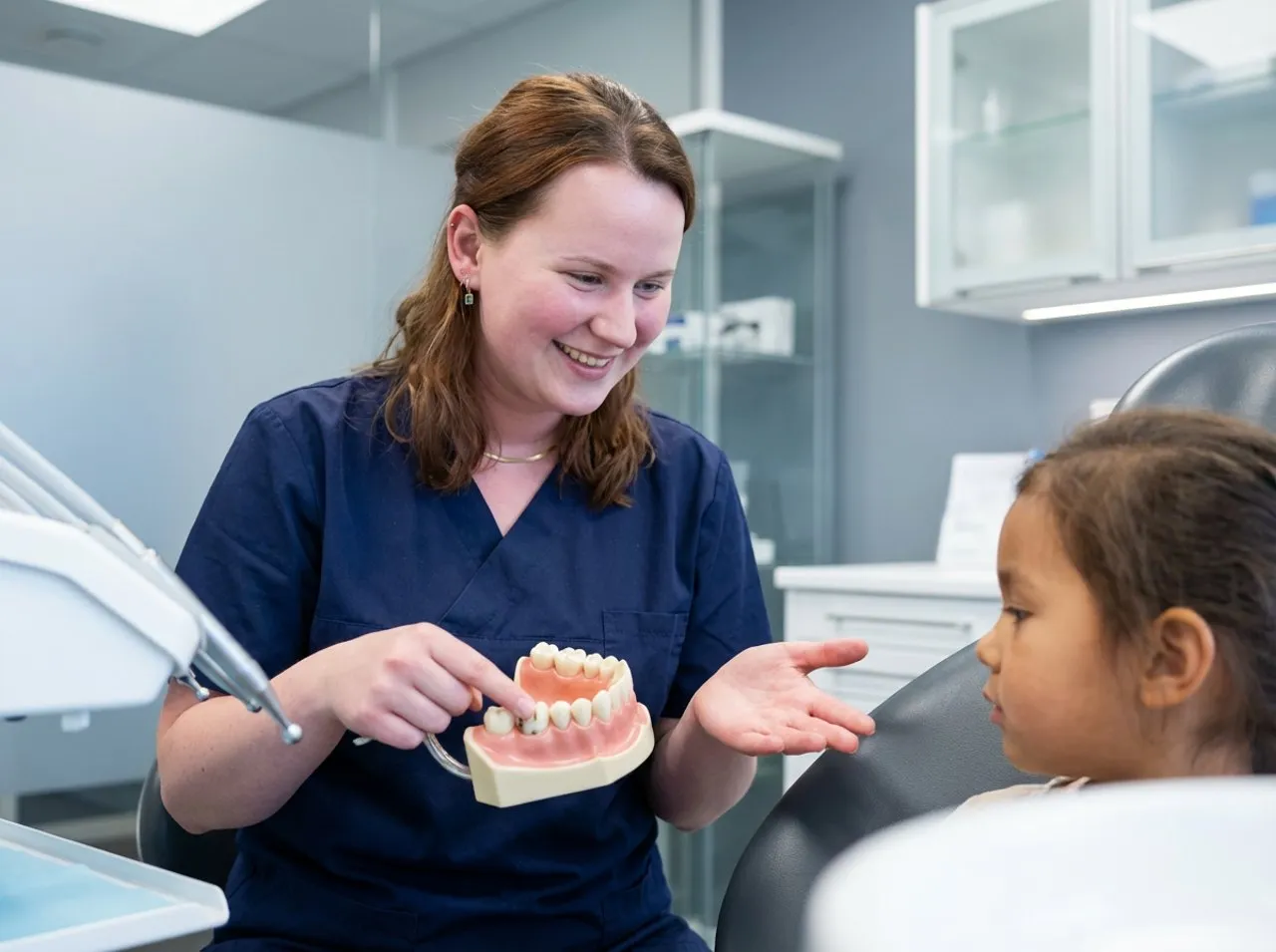
Milk teeth have their own area digits
For milk teeth, the areas are designated 5 to 8: upper right 5, upper left 6, lower left 7 and lower right 8. The second digit runs from 1 to 5. Milk teeth have no premolars; the rear positions 4 and 5 designate the two milk molars. Tooth 51, for example, is the central milk incisor in the upper right.
Different area digits may therefore appear in a finding during the change from milk teeth to permanent teeth. A milk tooth and its permanent successor are different teeth and have different codes. When reading a finding for your child, ask specifically whether it refers to the milk tooth or the permanent tooth. The guide to loose teeth explains this aspect of development separately.
A number does not describe a disease
A tooth number alone says nothing about tooth decay, gums, the condition of the root or the need for treatment. Additional details may describe, for example, a finding, a tooth surface or planned treatment. The dental team should explain what an abbreviation in your documents means. Do not infer that treatment is necessary from individual letters.
During the consultation, you can ask about three things separately: Which tooth is being referred to? What was found there? What treatment is planned and why? For a tooth with several visible restorations, the affected surface may also be important. The general explanation of a dental filling does not replace this personal discussion of your findings.
Other documents may use different numbering
Other systems are also used internationally, such as the Universal or Palmer notation. A single number in a report from another country may therefore not mean the same position as a two-digit FDI code. Translating the text alone does not explain the system used. Keep the original report together with any images and available explanations.
If you change dental practice, say which country or institution the documents come from. Ask for the system to be checked before the teeth are identified. Do not transfer information from an online table into a medical treatment plan yourself. If an entry is unclear, checking the original documentation is more helpful than assuming it must be a typing error.
Describing pain over the phone without a tooth number
You do not need to know a number to make an appointment. Describe whether the symptoms are in the upper or lower jaw, on the right or left, and at the front or back. Also mention when they started, any swelling, any accident and any difficulty eating. Radiating pain in particular cannot always be attributed to one tooth. An examination is more important for this than a seemingly precise number.
If you mention a number from previous treatment, say where you got it from. For example, you could say: ‘Tooth one six was last treated there; now the upper right side hurts.’ This distinguishes information already in your records from what you are currently experiencing. At your appointment, ask whether the same tooth really is affected. This allows the team to work with both pieces of information.

Understanding your personal treatment plan
Bring any unclear documents to the conversation and mark the entries you have questions about beforehand. If several teeth are involved, ask for the order of the procedures to be explained. A plan with tooth numbers can combine a great deal of information, but still requires explanation. The numbers make it easier to identify the teeth; they do not replace information about alternatives, risks or costs.
Your own brief note could look like this: number, location pointed out, finding, next step. Before leaving the practice, ask whether you have understood the information correctly. You do not need to memorise the entire tooth numbering system. What matters is that you can explain in your own words which tooth is involved and why it is being treated.
Related topics to read next
Frequently asked questions
In the FDI notation, it is in the upper right. The second digit, 6, designates the first molar. The number is spoken as ‘one six’.
It is the side of the person being treated. A diagram viewed as if it were another person facing you may therefore appear reversed. If you are unsure, ask for the side to be pointed out.
No. The position retains its code. A gap does not change the numbers of the neighbouring teeth.
Their areas of the dentition are designated 5 to 8 instead of 1 to 4. This distinguishes them from permanent teeth, including during the change from milk teeth to permanent teeth.
No. It identifies a position. The findings, examination and treatment planning determine whether treatment is needed.
No. Describe the side, area, symptoms and how they have developed. The team can identify the affected tooth during the examination.